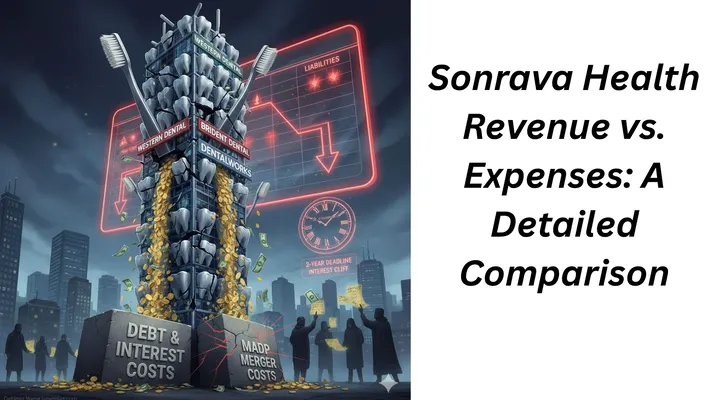
I. Executive Summary: The Core Financial Problem Leading to Crisis
Sonrava Health, which is known as Premier Dental Services Inc., is a nationwide company that serves nearly 600 dental practices in 21 states. The company made approximately $980 million in 2023. However, in comparison to the operating costs and debt, a significant structural issue evolves, resulting in extreme financial distress, once its high income is measured.
The company has made almost a billion dollars, but its high operating expenses combined with the unexpected expenses due to a major merger resulted in an unsustainable financial situation. The most apparent indicator was a massive cash loss, its Free Operating Cash Flow (FOCF) loss, which was projected to be between 100m and 110m in 2023. This high cash burn quickly exhausted the cash reserves of the company and its debt burden was not sustainable in the long term.
The drop was primarily due to three factors: (i) increased costs, that were above expectations, due to the acquisition of Mid-Atlantic Dental Partners (MADP) in June 2022; (ii) increasing costs in the industry; and (iii) excessive interest payments on the existing debt of the company.
To rectify the imbalance, the company went into a debt swap with lenders in June 2024–a painful but necessary act. Lenders were given lower ratings than what they were assured in which S&P Global Ratings classified the company as being in a selective default (SD) and then later upgraded it to a credit rating of CCC.
The grotesque difference between the scale of Sonrava and its dismal loss of cash-flow is an indication of a grave failure in its operations and cost management. Big dental service organizations (DSOs) usually save money through centralization of services like supply procurement. The failure of Sonrava to contain its costs to the point of registering a loss of cash that goes beyond 10 percent of its annual revenue means that the MADP merger in fact negated central cost benefits and efficiency as opposed to bringing them.
II. Sonrava Health’s Income Sources and Scale (The $980M Base)
A. The Combined Business Model and Revenue Streams
Sonrava Health is the parent company of a number of dental brands, including Western Dental, Brident Dental and Orthodontics, Vital Smiles, and acquired brands including DentalWorks and Perfect Teeth. These centers collectively serve approximately 4million patients annually.
The company has a dual-stream model that generates two distinct sources of revenue, which gives it a more reliable financial base than the one that forces it to depend on patient fees exclusively:
- Patient Care Services: This is the main source of income. It is based on charges set on the wide range of dental services including routine cleanings and more complicated surgeries, like orthodontics and oral surgery. The revenue is determined by the amount of patient visits, type of treatments provided (the more complex a service is, the higher its income), and payment rates that a treatment center negotiates with insurance companies.
- Affiliated Insurance Plans: Sonrava is also gaining revenue by its own vision and dental benefit plans (e.g. EyeMax Vision Plan and MIB Insurance Plans). Member contributions in the form of premiums generate a predictable and consistent stream of revenues that enable the firm to seize revenue sources both through insurance premiums and cost of care.
B. 2023 Revenue Baseline and Current Challenges
The good performance of the company in 2023 resulted in a high revenue base of about 980million dollars. This revenue is however now strained. S&P Global Ratings forecasts a 6 percent to 7 percent reduction in the revenue of Sonrava in 2024.
This decline is primarily due to the impact of Medicaid redeterminations on the industry sector as a whole. Sonrava has which patients are served by it in large numbers via public health programs, and therefore it is susceptible to alterations in patient enrolment. The reduction in the number of eligible patients implies a reduction in the number of paid visits. This downward trend is also explained by the fact the management intends to sell off unproductive offices. This will decrease the overall revenue in the short run but will assist the profitability in the future.
C. 2025 Revenue Growth Plans
It is the hard work of the management to stabilize the patient volumes by optimizing and marketing. Such measures will begin to ease the situation with patient numbers in the first half of 2025 and may see the year projected to reduce growth in the mid-single-digit percent.
One of the key areas of operation is the enhancement of Revenue Cycle Management (RCM) operation, where billing and collections of money are done. The fact that a Senior Vice President of RCM, an experienced executive, was hired reflects a strategic emphasis on correcting collections, enhancing the processing of payments, and simplifying operations.
The urgent fear is that the projection of the decrease in revenue 6% to 7% in 2024 worsens the cost issue significantly. Because its fixed and semi-fixed costs were already higher than its revenue (leaving the company with a shortage of cash), they will now eat an even greater share of a smaller income base. It entails that the company requires colossal reduction of costs in order to remain on the same level. Insurance plan revenue could not cover the immediate loss of patients as a result of the changes in Medicaid.
III. How Core Operating Costs Are Structured
The survival of Sonrava depends on its capability to utilize the size to operate efficiently and maintain the costs at the industry rates. However, the company has been experiencing difficulties in achieving a stable financial performance, despite its size, indicating the weaknesses in the cost-management component which cannot be compared to the industry standards.
A. Industry Dental Cost Pricing Targets
Dental Service Organizations use the specific measures of efficiency. By way of illustration, an average dental office will aim at a net profit margin of around 28%. Big DSOs have to be very efficient at operating (EBITDA margins) to address their big central overheads, and debt costs.
Industry targets help put Sonrava’s current “cost take-out initiatives” into context:
Table 1: Key Dental Service Organization (DSO) Expense Benchmarks
| Expense Category (As % of Collections/Revenue) | DSO Industry Standard Target | Significance for Sonrava |
| Staff Payroll (excluding Doctor/Owner) | 20% – 24% | Confirmed target for current “cost take-out initiatives” , suggesting labor costs were too high. |
| Dental Supplies | 5% – 6% | Should be kept low using the power of central purchasing. |
| Lab Fees | 8% – 10% | A major cost that varies with the complexity of procedures. |
| Rent/Facility Costs | 4% – 6% | Challenge of managing nearly 600 offices. |
B. Sonrava Health’s Major Cost Components
The spending of the company can be divided into three broad categories:
- Staff and Provider Pay: Labor is the most expensive healthcare expense. It encompasses payment of salaries and taxes and benefits of staff, hygienists and other support staff in the clinic. Upon the absorption of MADP staff, the payroll costs were more than the efficient levels and they would continue to be reduced.
- Clinic Operations and Supplies: It includes rent, utilities, insurance, and dental supplies daily costs. The centralized model created by Sonrava saves these costs by buying in quantities and supplies and equipment to all offices.
- Centralized Administrative and Marketing (G&A) Overheads: G&A overheads are indirect expenses that are needed to operate the business but do not relate to patient care. When operating in a large multi-state DSO they have corporate headquarters, IT, legal, HR and billing and collections centralized (RCM). Marketing and advertising is also a big aspect of G&A and plays a critical role in drawing patients to Western Dental and Brident brands.
The inherent defect in operations was inadequate integration and the bad management of the administration that set the G&A costs ablaze than planned. The crisis started with the company being struck by high costs of integration and swings in the working-capital. In healthcare, the working-capital issues normally indicate problems with the Accounts Receivable (A/R) -the process of submission of claims and collection of payments. The introduction of a new CFO Krishna Maridi, and a new Senior VP of RCM implies that billing and collections had not been effectively integrated. Payment delays paralyzed cash flow making G&A spending, which should have generated efficiency, a huge cost to profits.
IV. The Crisis Point: Integration Costs and Cash Flow Losses
A. The Mid-Atlantic Dental Partners (MADP) Acquisition
The most significant event that caused Sonrava to run into financial trouble was the acquisition of Mid-Atlantic Dental Partners (MADP) in June 2022. The acquisition brought in 215 offices in 17 states bringing the total Sonrava network to 572 offices. The idea was to develop a national dental group.
B. The Acquisition Overrun of the Expense
The anticipated effects of scale were not felt. Rather, the merger brought central operations issues. According to S&P Global, MADP acquisition had temporary and persistent operational problems at Sonrava, and increased costs and interest payments.
These issues resulted in long-term negative cash flow, fuelled by two major cost drivers which got out of control:
- Unexpectedly High Integration Costs: The credit downgrade in late 2023 was specifically tied to unexpectedly high expenses incurred while trying to merge the acquired practices.
- Higher-than-expected working capital fluctuations: The integration process disrupted cash flow, particularly concerning the speed and reliability of collecting payments.
C. 2023 Cash Loss Analysis
This resulted in a forecasted cash loss (FOCF deficit) of $100 million to 110 million dollars in 2023 due to the high running costs, increasing inflation and the catastrophic MADP merger. That indicates how dire the financial condition of this company was: the enterprise was burning over $100 million annually even after it met all operating costs, needed equipment acquisitions, and interest payments. This was not a sustainable deficit that became increasingly draining as the cash bank dwindled and now the company had just about six months to go by the end of 2023.
The challenge of having to make additional investments to scale up the acquired MADP practices supports the fact that Sonrava grossly underestimated the effort and capital it would take to incorporate the 215 newly acquired offices into its central system. This is an indication that the MADP offices were characterized by weak technology, dysfunctional back-office operations or poor billing processes before the acquisition. Sonrava inherited and increased these issues making a planned growth driver a crippling problem that necessitated unanticipated spending and cash burn due to delayed collections.
V. Debt Burden, Interest Costs, and Financial Instability
A. Debt Before Restructuring
Before the recent debt changes, the high interest expense was a major, fixed cost preventing the company from being profitable, and it significantly contributed to the sustained cash losses throughout 2023. The high debt service meant that even good operating profit (EBITDA) would be mostly consumed by interest payments, leaving too little cash for necessary business investments like facility upgrades or improving billing systems.
B. The June 2024 Distressed Debt Exchange
The severe lack of cash forced Sonrava Health (Premier Dental Services Inc.) to perform a distressed debt exchange on June 14, 2024. This deal, where existing lenders accepted less than what they were contractually owed , was classified as a “selective default” (‘SD’) by S&P Global Ratings before the rating was subsequently raised to ‘CCC’. Lenders were forced to agree to lower priority claims, lower cash interest rates for the first two years, and reduced debt repayment schedules.
The new financial structure provided immediate, temporary cash relief but came with significant long-term costs :
- Cash Injection: The deal provided $51 million of extra cash, giving the company a short-term buffer.
- Debt Increase: The restructuring simultaneously added about $114 million in total debt, which included capitalized interest (a Pay-in-Kind premium). This means the debt was reorganized, not significantly reduced, increasing future repayment obligations.
- Financial Constraint: The new credit agreement imposes a strict minimum cash covenant of $35 million, tested monthly, severely limiting the company’s financial flexibility.
C. The Critical Interest Payment Cliff
The debt exchange only delayed the debt maturity problem, creating a tight deadline. While the deal provided immediate cash interest savings of $20 million to $25 million annually for the next two years , the total debt remains high. S&P projects the yearly interest costs (excluding finance leases) will still be in the $60 million to $65 million range over the next 12 months.
The fundamental risk lies in the “interest cliff”: after the initial two years of cash savings, the cash interest burden will increase substantially by $30 million to $35 million. This required increase creates an urgent deadline. Sonrava must achieve a complete business reversal and generate significant cash flow within this 24-month window. This cash flow must be enough to cover the existing $60 million-$65 million interest expense and absorb the extra $30 million-$35 million hike afterward. The restructuring bought time, but it did so by increasing the size of the principal debt that needs to be paid back.
Table 2: Impact of June 2024 Debt Exchange
| Financial Component | Value/Range (USD Millions) | Significance |
| 2023 Cash Loss (Pre-Restructuring) | $100 – $110 | Shows the unsustainable rate of cash being burned. |
| Annual Interest Costs (Initial 12 months) | $60 – $65 | Base interest cost despite initial savings. |
| Annual Cash Interest Savings (Year 1 & 2) | $20 – $25 | Temporary cash flow relief from reduced cash rates. |
| Projected Cash Interest Increase (Post-Year 2) | $30 – $35 | The “interest cliff,” substantially increasing fixed costs later. |
| Incremental Cash Added | $51 | Short-term buffer to survive the immediate cash crisis. |
| Minimum Cash Reserve Rule (Covenant) | $35 | Strictly limits financial flexibility; tested monthly. |
VI. Efficiency Goals and Turnaround Plan
To achieve financial stability, Sonrava must close the wide gap between its large revenue base and its negative cash flow, mainly by cutting targeted expenses and boosting operating profit (EBITDA).
A. Management’s Plan to Cut Costs
Management started aggressive cost control plans aimed at increasing margins and getting operating profit back on track. S&P forecasts that these efforts should lead to modest profit growth in the second half of 2024 and into 2025. Key parts of the plan include:
- Labor Cost Reduction: Explicit “cost take-out initiatives on labor” are ongoing. This confirms that staff costs—the largest operating expense—were inflated, likely due to inefficiencies from the MADP merger, pushing them above the benchmark 20%-24% of revenue.
- Selling Bad Offices: The company focuses on the sale of underperforming practices. This strategy is necessary to improve the average profit margin of the remaining offices and stop the losses from financially weak or non-core assets.
B. Fixing the Billing and Collections Process (RCM)
Fixing the past problems with cash flow disruptions and collection delays is crucial. The strategic appointment of a Senior Vice President of RCM is a direct step to fix this administrative weakness. The new leader must drive company-wide changes, optimizing processes, and improving systems across the revenue cycle. Effective RCM is vital for turning earned revenue into timely cash, reducing claim rejections, and ensuring predictable collections cover operating expenses.
The success of the entire restructuring depends entirely on how quickly and how much operating profit improves. S&P forecasts only “modest EBITDA growth” from these cost cuts. Given the starting point of a $100 million to $110 million cash loss and the expected revenue drop in 2024 , a “modest” improvement is mathematically insufficient to cover the fixed $60 million-$65 million interest cost and generate positive cash flow, let alone prepare for the $30 million-$35 million interest hike scheduled for 2026. The current pace of operational improvement appears too slow relative to the strict demands of the revised debt structure. This gap indicates the underlying deficits are too severe for a short-term fix.
VII. Financial Risk and Future Outlook
A. Current Credit Rating and Cash Position
Following the debt exchange, Sonrava Health holds an Issuer Credit Rating of ‘CCC’. This rating signals an extremely high risk and means that the financial structure is viewed as “likely unsustainable due to continued operating challenges.”
Although the June 2024 restructuring provided $51 million in temporary cash, the limitations on financial freedom remain severe, emphasized by the $35 million monthly minimum cash covenant.
B. Cash Flow Predictions and Future Default Risk
S&P Global Ratings analysis indicates that Sonrava will likely “generate cash flow deficits over at least the next 12 months,” even after the debt changes and initial cost-cutting efforts. The negative outlook shows the view that ongoing operational problems could further reduce revenue and operating profit, quickly using up the temporary cash buffer.
The main structural failure is the gap between management’s ability to improve operations and the high fixed cost of servicing its debt. Credit rating agencies conclude that without the ability to significantly increase revenue and cut costs quickly, it is “likely that the company will engage in another restructuring over the next 12 months”. S&P explicitly views a subsequent default as inevitable within the next year. The $51 million cash injection, in this context, acts only as a temporary fix, not a structural solution, for the core cash flow issues caused by the acquisition and debt service.
Table 3: Projected Sonrava Health Financial Overview (2023-2025 Outlook)
| Metric | 2023 Actual/Expected | 2024 Forecast (S&P) | 2025 Forecast (S&P) |
| Total Net Revenue | ~$980 million | Decrease 6%-7% | Mid-single-digit growth |
| Cash Flow (FOCF) | $100 million – $110 million Loss | Expected Cash Flow Losses | Expected Cash Flow Losses |
| Major Problems | MADP Merger Costs, High Interest, Inflation | Medicaid Enrollment Changes, Billing/Cash Pressure | High Debt Service (Interest Cliff Post-2025) |
| Operating Profit (EBITDA) Trend | Highly Negative/Weakened | Modest growth H2 2024 due to cost cuts | Modest growth |
| Cash Availability (Liquidity) | Low (Downgraded to CCC+) | Very Constrained ($51M added, $35M minimum rule) | Continued Pressure (Future Default Risk) |
C. Conclusions on Long-Term Viability
The analysis of Sonrava Health’s revenue versus its expenses highlights a structural weakness where high operating costs (especially inefficient management and staff costs after the acquisition) and massive debt payments consistently outweigh the company’s ability to earn money.
The June 2024 debt restructuring only bought a minimal amount of time by temporarily lowering cash interest payments. It failed to fundamentally change the negative cash flow trend or the massive principal debt burden. The two-year deadline to become profitable is extremely tight, and the “modest” improvements expected are highly unlikely to generate the profit needed to avoid the substantial interest rate increase scheduled to start in 2026. As a result, the company remains highly vulnerable, and further changes to its financial structure are very likely within the next 12 to 24 months.