Introduction
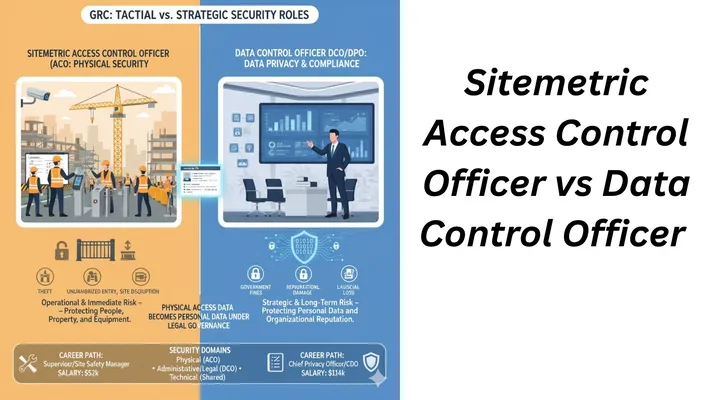
Risk management is handled in very different manners by both the Sitemetric Access Control Officer (ACO) and the Data Control Officer (DCO). They secure various assets, have different laws, and they are found in different positions of an organization Governance, Risk, and Compliance (GRC) structure.
The ACO operates locally and deals with short-term, physical dangers. It is their responsibility to prevent unauthorized access of people and to secure property. This is essential in high-risk environments with high traffic, like construction sites and factories, where Sitemetric connected jobsite and workforce platforms are applied. Physical Security Checks are carried out by ACOS in order to prevent theft, loss, or injury before it occurs.
The DCO, commonly referred to as the Data Protection Officer (DPO) in the international rules, in contrast, deals with long-term, macro-risks. This is their main aim to lessen legal and financial liabilities that accompany the management of personal data. They have adopted Checks on Management and Legal where they are concerned about whether the company is fulfilling the legal requirements and whether its regulatory responsibility is being handled.
The fundamental task of the ACO is to reduce the risks in the daily life: damaged gates, unauthorized access, abandoned working places. The unsuccessful performance in this area results in direct quantifiable losses of money or injuries. However, the DCO cushions against long-term and material risks like massive government fines, which could constitute a good chunk of the world revenue, and a massive loss of reputation.
Such disparity in the time and price of risks determines the power and experience needed by each role. ACO requires hands-on, on-the-job security experience and the DCO seeks a professional and legal background at the high-level.
II. The Data Control Officer (DCO/DPO): Job, Authority, and Rules
A Data Protection Officer (DPO) or Data Control Officer (also called DPO) is a specialized position which is frequently legally obligatory. It only deals in information governance and compliance. The international data protection law goes beyond the normal responsibilities of the data protection officer and makes him or her a part of a group of professionals dealing with security issues.
A. Why the Law Requires It: Starting with GDPR and Major Privacy Laws
The necessity of the DCO/DPO position is the direct result of strict data protection regulations, in particular the general data protection regulation (GDPR) in the European Union. The essence of the work is to ensure that the organization manages the personal data of everyone, employees, and customers, as well as providers (data subjects), in complete adherence to the applicable rules. This necessitates that one should continuously be familiar with as many data protection laws as possible, such as the California Consumer Privacy Act (CCPA), depending on the location of operation of the organization.
The DCO provides administrative controls throughout the company. They educate employees on the requirements of GDPR and respond to data-subject questions on the use and protection of data. They also gain risk-management skills, which identify possible data-security threats and mitigate them. It includes managing technology options, such as encryption, anonymization, pseudonymization, which protect data. The DCO also maintains comprehensive documentation of the entire processing operation and conducts periodic audits to ensure that it still adheres to compliance.
B. Where the Job Sits and Its Freedom (The Authority Model)
One important aspect of the DPO that distinguishes it among the majority of on-site security positions is its independence mandate and its positioning in the corporate organization. The data protection law requires the DPO to report to the topmost management- normally the board. The strategic value that the law places on data privacy is highlighted by the fact that it is a direct line to senior executives.
This is an exceptional structural necessity that ensures that the DPO is independent and is able to discharge its responsibilities without any conflict of interests. DPO is not supposed to be discharged or punished to execute its duties. Independence is essential since the fundamental activity of the DPO is to audit the data processing by senior managers in different departments (IT or marketing), and it should be free to find fault with decision-making that can bring compliance risks without repercussions. The DPO is an internal auditor and legal compliance watchdog, and the Access Control Officer performs working duties. In order to facilitate the DPO to keep professional knowledge and ensure that the DPO performs its responsibilities efficiently, organizations need to supply resources to the DPO adequately in time, money, infrastructure, and personnel.
III. The Sitemetric Access Control Officer (ACO): On-Site Security and Site Safety
Sitemetric Access Control Officer (ACO) operates in the physical aspect of organizational protection, whereby they ensure that assets and human beings in a busy industry are secure in the industrial premises.
A. Daily Security and Industrial Workplace
This job is categorized as Sitemetric Access Control Officer, which places the job firmly in operational security in the construction and factory environment. The technology services of Sitemetric change the management of a site by providing integrated jobsite and workforce service offerings that enhance site security and safety. Since the workplace is dynamic, the ACO is expected to be versatile, meticulous and usually require a year of practical experience in either construction or industrial setting.
The ACO primarily has as its main role both standard physical controls and their backup computer systems. Hardware used in physical controls includes gates, locks and card readers and personnel including guards who validate IDs. Physical control is supported by digital access-control systems-software that provides access control, records entries and tracks movements. These day-to-day controls satisfy the important information-security requirements such as the NIST requirement to control and manage physical access controls.
B. Day-to-Day Tasks: Action and Record Keeping
The ACO implements rules on the frontline as far as sites are concerned. Their main responsibilities are to actively keep track of personnel in and out of the premises as well as checking out badges, and ensuring proper headcount. These activities are crucial towards emergency operations and general safety on the site.
In addition to personnel, the ACO deals with logistics where all visitors and deliveries are registered and additional functions, such as issuing parking passes and managing parking compliance, are performed. They also work in the area of several access-control tasks, such as basic technical troubleshooting, and badges, worker sign-ups, and badges. The measures taken by the ACO are designed to mitigate the threats to the immediate safety and maintain the physical security of the organization, which is mostly achieved via physical and technical security inspections.
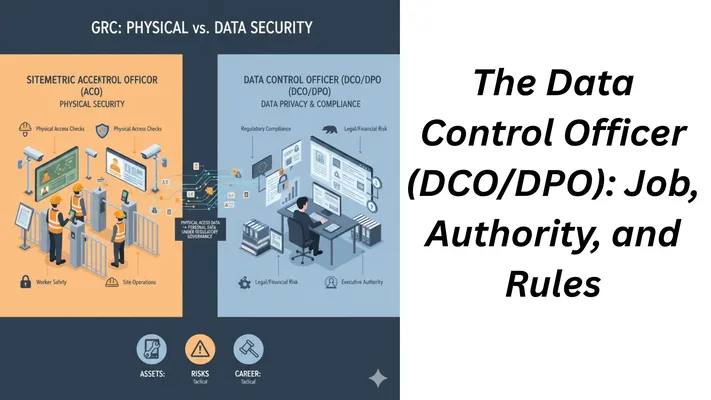
The primary connection of the roles is the information the ACO can produce. The ACO follows the movements and identities of people using digital access-control software, which prepares sensitive records of operations. These identity records and movement logs are personal data; their processing is the subject of the regulatory governance of the DCO. The ACO assists in ensuring that data systems are kept confidential, intact and available as an enforcer of policies at the frontline- by ensuring that such facilities like physical server rooms are secure.
IV. Comprehensive Comparison: A Framework for Distinction in GRC
The assignment of roles to security controls accepted by the industry allows making a clear distinction between these functions and demonstrate where each of them lies in the risk reduction hierarchy. Security controls, are countermeasures which reduce the likelihood of a threat doing so based on a vulnerability, and are of 3 broad categories: Technical, Administrative, and Physical.
A. Mapping Roles to the Three-Part Security Checks Model
The DCO works mainly in the Administrative/Legal sphere, while the ACO works mainly in the Physical area.
Table 3: Role Mapping to Security Control Classification
| Control Type | Sitemetric Access Control Officer (ACO) | Data Control Officer (DCO/DPO) |
| Administrative/Legal | Low-level execution of site safety rules, procedural logs, and policy adherence. | High-level strategy: Developing policies, staff training, legal compliance, risk assessment methods, and liaison with supervisory authorities. |
| Technical | Operation and basic maintenance of dedicated physical access control systems (hardware and software interfaces). | Governance over the implementation of data protection technologies (e.g., encryption, anonymization, data security systems). |
| Physical | Primary Domain: Implementing and enforcing physical controls over facility and asset access (gates, locks, ID verification). | Indirect Input: Defines what physical protection is necessary to safeguard IT assets; relies on the ACO/Facilities team to carry out the task. |
B. Difference in Protected Assets and Risk Types
The separation in organizational goals is evident in the types of assets each officer is mainly tasked with defending. The DCO is fundamentally concerned with reducing Legal and Financial Risk stemming from the misuse or exposure of data, while the ACO is concerned with reducing Operational and Safety Risk stemming from the violation of physical space.
| Parameter | Sitemetric Access Control Officer (ACO) | Data Control Officer (DCO/DPO) |
| Primary Asset Focus | People safety, physical building and equipment, site gear, ongoing operations. | Non-physical asset: Personal Data (privacy, compliance, reputation). |
| Regulatory Framework Focus | OSHA/Site Safety Rules, Physical aspects of NIST SP 800-171. | GDPR, CCPA, and other global data privacy laws. |
| Critical Risk Reduced | Theft, getting onto the site without permission, spying, physical harm, site disruption. | Government fines, lawsuits, loss of trust, harm to reputation, failure of rules. |
The DCO should report to the board as it will signify that the organization takes the risks of data-privacy losses, including non-compliance with GDPR, as potentially devastating to its financial sustainability. On the contrary, the ACO is concentrated on client experience and daily operations and performs risk-reduction activities at the site level. This differentiation indicates that the DCO and the ACO are legal and governance and operational specialists, respectively, with the strategic significance and responsibility of each of them largely contrasting.
V. Career Path, Needed Skills, and Pay Comparison
The two professions are opposites in terms of their work needs, specialization and worth in the market. The DCO is considered a broader, multi-disciplinary executive role, as compared to the ACO, which is considered to have specialized, on-site operational experience.
A. Required Competencies and Certifications
The Data Control Officer needs to be able to master the cross points of law, IT, risk management, and compliance. It needs a high level of understanding of the process of data collection, storage, handling, and deletion, along with the technologies that are used to assist it.
Table 4: Comparative Skill Requirements
| Skill Aspect | Sitemetric Access Control Officer (ACO) | Data Control Officer (DCO/DPO) |
| Required Background | Hands-on experience in construction/industrial settings, security operations, physical access systems. | Advanced knowledge in IT, law, risk management, or compliance. |
| Essential Certifications | System-specific training, Physical Security/CCTV certifications. Career advancement often requires certifications in cybersecurity or physical security. | Mandatory privacy and security certifications: Certified Information Privacy Professional (CIPP), Certified Information Privacy Manager (CIPM), Certified Information Systems Security Professional (CISSP). |
| Core Soft Skills | Detail-orientation, Flexibility, Problem-Solving (site/hardware issues), Clear operational communication. | Leadership, Strategic communication with stakeholders, Ability to train staff on complex legal rules, Ethical judgment. |
The mandatory nature of high-level professional certifications for the DCO, such as CIPP and CISSP , confirms that this is a specialized, intellectual function guided by professional standards. These credentials are required for the DCO to maintain the required independence and expertise to advise the C-suite on complex legal matters. Conversely, the ACO path emphasizes practical experience, often leveraging technical proficiency in machine operation or specialized systems.
B. Pay and Career Advancement Benchmarking
The salary differential is the clearest sign of the market value of strategic legal risk versus tactical on-site risk management.
Table 5: Compensation and Career Progression Benchmarking
| Metric | Sitemetric Access Control Officer (ACO) | Data Control Officer (DCO/DPO/Data Governance) |
| Average U.S. Annual Salary | ~$51,962 (Operational/Tactical) | ~$113,939 (Strategic/Governance) |
| Upward Mobility | Security Officer Supervisor, Facilities Security Director, Site Safety Manager, Access Control System Integrator. | Chief Privacy Officer (CPO), Chief Data Officer (CDO), VP of Regulatory Compliance, or specialized Legal Counsel. |
The comparison reveals a high pay difference: an average salary of a Data Governance Officer is higher than an average salary of an Access Control Officer by a larger margin. The strong distinction of this difference highlights the fact that the expertise in handling legal obligations within the data economy is several times more appreciated than the competencies that are necessary in managing physical access. The DCO is a senior-executive position with an obvious upward career trajectory, which leads to Chief Privacy Officer (CPO) or Chief Data Officer (CDO). These senior positions influence the company strategy with data governance, as the cost of hiring senior talent to avert millions of dollars in government fines is high.
VI. Bringing it Together: Steps for Better Security
The ACO and DCO functions are bound together by the concept of control though they may be handled by different departments such as Security versus Compliance. This needs to be combined into one GRC strategy so that there are no perilous security blind spots.
It is necessary to have cross-functional collaboration, since data is generated by physical security systems. Sitemetric systems operated by the ACO track the people entering the site, and the place and time. Such movement records and identity database are personal information, and therefore their processing comes directly under the regulatory jurisdiction of the DCO.
A compliance gap arises when the on-site ACO team retains access logs indefinitely due to the convenience of operation, e.g. by giving the customer a reference. This action contravenes data-minimization and retention policies of the DCO as mandated by GDPR/CCPA, putting the organization at a high risk of a huge, unintentional legal liability. The biggest threat lies in the fact that most often, physical security is considered to be absolutely independent of data governance.
These two roles are mutually exclusive. The DCO establishes administrative controls- e.g. a policy that requires only authorized and logged personnel to access the data center floor. The ACO implements physical controls–e.g., badging access and door logs. The two functions are important to ensure the security and privacy of the organization. Thus, an adult GRC architecture should understand that the physical location of the data assets and the operational records created by the physical security systems are heavily administratively and legally regulated.
To reduce organizational silos and establish a mature control environment, the following structural recommendations are essential:
- The ACO and DCO functions are bound together by the concept of control though they may be handled by different departments such as Security versus Compliance. This needs to be combined into one GRC strategy so that there are no perilous security blind spots.
- It is necessary to have cross-functional collaboration, since data is generated by physical security systems. Sitemetric systems operated by the ACO track the people entering the site, and the place and time. Such movement records and identity database are personal information, and therefore their processing comes directly under the regulatory jurisdiction of the DCO.
- A compliance gap arises when the on-site ACO team retains access logs indefinitely due to the convenience of operation, e.g. by giving the customer a reference. This action contravenes data-minimization and retention policies of the DCO as mandated by GDPR/CCPA, putting the organization at a high risk of a huge, unintentional legal liability. The biggest threat lies in the fact that most often, physical security is considered to be absolutely independent of data governance.
- These two roles are mutually exclusive. The DCO establishes administrative controls- e.g. a policy that requires only authorized and logged personnel to access the data center floor. The ACO implements physical controls–e.g., badging access and door logs. The two functions are important to ensure the security and privacy of the organization. Thus, an adult GRC architecture should understand that the physical location of the data assets and the operational records created by the physical security systems are heavily administratively and legally regulated.
VII. Conclusion: The Integrated Future of Control
The Sitemetric Access Control Officer (ACO) and Data Control Officer (DCO) are also different but complementary to the enterprise defense. The ACO has tactical and on-site risk physical assets and site safety through experience in physical security and site management. The DCO addresses strategic, high-level risk of intangible assets- personal data- with the power of legal requirements and regulatory control. The disparities in the level of professional skills and the location of the position (operational and board levels) as well as remuneration demonstrate that the market is much more interested in the capacity of the DCO to minimize the catastrophic legal liability than in the attention to the prevention of local operational disturbance paid by the ACO.
Contemporary risk management demands that data, irrespective of its source should be considered an asset that is regulated by law. Physical access-control systems are inherently creating personal information that is vital in controlling security on site, but extraordinarily sensitive legally. As such, the ACO and DCO should work closely together. The long-term safety of any large, regulated firm lies in its formal inclusion of the administrative policies of the DCO in the day-to-day enforcement operations of the ACO, and elimination of the gap between the physical and regulatory levels of security management.
FAQs
1. What is the main difference between the ACO and the DCO?
The ACO manages physical security (people, gates, and equipment) at a specific site, focusing on immediate operational risk. The DCO manages data privacy and compliance across the entire organization, focusing on long-term legal and financial risk.
2. What are the core responsibilities of a Sitemetric Access Control Officer?
They monitor all personnel entering and exiting the site, verify identity using badges, maintain accurate headcount records, manage visitors and deliveries, and handle basic technical troubleshooting for access systems.
3. What critical assets does the Data Control Officer protect?
The DCO is primarily concerned with protecting the organization’s intangible assets, specifically personal data, ensuring its privacy, integrity, and compliance with global laws.
4. Why must the Data Control Officer report to the highest level of management?
Data protection law requires the DCO (or DPO) to report directly to the board level. This ensures they maintain independence and have the necessary authority to advise senior management on data protection issues without conflict.
5. What is the Data Control Officer’s role regarding data laws like GDPR?
The DCO is responsible for monitoring compliance with data protection laws, conducting regular assessments and audits, and training staff on how to handle personal data correctly.
6. How do the necessary skills compare for these two jobs?
The ACO needs practical experience in industrial settings, attention to detail, and technical skills for physical systems. The DCO requires advanced knowledge in IT, law, and risk management, often holding professional certifications like CIPP or CISSP.
7. How do the physical security actions of the ACO affect the DCO?
When the ACO uses digital access control systems to track who enters a site, they create logs of personal data (movement, identity). The processing of this data immediately falls under the DCO’s governance and privacy rules.
8. What is the typical difference in career progression?
The ACO path often leads to roles like Security Officer Supervisor or Site Safety Manager. The DCO path is typically a senior-executive track, leading toward positions like Chief Privacy Officer (CPO) or Chief Data Officer (CDO).
9. How do the average salaries differ between these two roles?
In the US, the average salary for a Data Governance Officer is significantly higher, around $113,939 annually, compared to the average salary for an Access Control Officer, which is around $51,962 annually.
10. What are the three main types of security checks used by both roles?
Security controls are classified into three types:
Physical (used heavily by the ACO, e.g., locks and guards)
Technical (used by both, e.g., encryption for data or badge scanners for access)
Administrative/Legal (used heavily by the DCO, e.g., written policies and training)