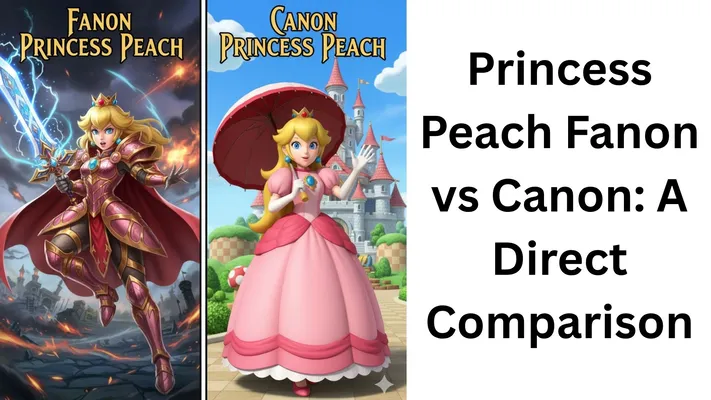
I. The Official Story: Peach’s Standard Role and How It Changed
1.1. Starting as a Trope: Peach as the Princess Who Needs Saving
Princess Peach Toadstool is based on the Damsel in Distress (DiD) model, which she has been playing since her inception in 1985. Peach is a real-life princess and the sovereign of the Mushroom Kingdom. Her main traits are that she is a bubbly, innocent, and kind-hearted girl, and rules kindly and politely. Her earliest appearances solidified her status as a plot device, the prize that was stolen and must be used to get the main character, Mario, on the road. In core games like
There was not much dialogue of hers in Super Mario World and Super Mario Bros., usually, Help me! or those shouts, which reinforced the role of a victim to be rescued.
Analysts are inclined to call this role in repetition the objectified ball or disposable woman who is tossed between the male protagonist and the male villain, or bad guy. This constant critique led to a rise of expectations on the fans to gain more agency and had a direct influence on how Nintendo treats her in the future.
Even though the DiD model is highly prevalent in the core games, we begin to encounter in the official narrative the initial premises of resistance against this unchallenging role. Her introduction as a playable character in Super Mario Bros. 2 (USA) gave Peach her floating ability, the first time she is an effective adventurer. This has its own formal paradox: Peach continues to reprise the DiD role in major 3D marquee releases (e.g.,
The simple story of rescue is used in Super Mario 64 and Super Mario Odyssey to encourage exploration, although she is also active and strong in her spin-offs, 2D platformers, and RPGs. This difference signifies that Nintendo was strategically shifting between the requirements of the corresponding genres with the utilization of the role that they had always used when presenting flagship products and testing the heroic potential of other games.
1.2. The Kind Ruler: Her Official Personality and Skill at Peace
The real depth of Peach is not in physical strength, which is always demonstrated to be a secondary attribute compared to such characters as the Mario Bros. and Bowser, but in her inner strength and her ability to lead. Formal accounts emphasise that she was kind, noble-minded, and of immense strength of will. Through her moments of resilience, she is strong in key moments of the story, like resisting intense dark magic and the villain’s brainwashing, like Nastasia and the Shadow Queen. This inner resource is a crucial component of her power base, which is not always considered when concentrating on her physical frailty.
Being a ruler, Peach is an active ruler who governs the kingdom and composes peace. Official ones can be listed as participating in peace negotiations with external forces, like the Beanbean Kingdom in Mario and Luigi: Superstar Saga, and hosting events aimed at uniting her subjects who lived in different parts of the Mushroom Kingdom. There is some evidence that she manages a modern, complicated state, with the government financing state endeavors, such as hospitals, malls, and cars, as well as huge outlays such as stadium construction. The real official strength, her real soft power, a brilliant paradox to the direct and destructive fighting of the male heroes and bad guys, is her benevolence and her diplomatic nature. Her stability and, more importantly, her innate strength to undo the most powerful dark magic spells by Bowser are powers that are necessary in governing and safeguarding her people.
The reasons why she still goes by the name Princess Peach, even though she is the only ruler of the Mushroom Kingdom, frequently come up in fan discussion. Although it is always said by fans that she is technically a Queen, the official account keeps the title of the Princess. A common theory states that Peach intentionally maintains this status to either preserve the traditions of her kingdom or, in an effort to appear to be seen as dainty and pretty, thereby unable to be labeled as uncivilized by her own people or even the foreigners.
1.3. Flipping the Role: Her Own Heroic Adventures in the Official Story
The biggest official modifications to the stories are in the titles, where Peach is the protagonist and the DiD role is reversed. These heroic games without a main story act as intended narrative alterations, which are a commercial reaction to the extratextual pressure on female agency.
Super Princess Peach (2005) was the first large-scale flip and explicit reversal of the fundamental dynamic, with Peach explicitly being forced to rescue a captured Mario and Luigi. The game also showed the hotly disputed Vibe powers, in which the power (fire, healing power, and flying power) of Peach was the result of a strong emotional response (Imitation, Joy, Rage, Calm, Sadness) to the Vibe Wand. Although the game was criticized as possibly reinforcing emotional stereotypes, it clearly made Peach a powerful, competent heroine who could surmount challenges with a set of powers unavailable to other heroes.
This development goes to the point of Princess Peach: Showtime! (2024). In this game, Peach uses a magical ribbon to temporarily take on transformation-based combat roles like Mighty Peach, SwordFighter Peach, and Ninja Peach. The game reveals her greatest magical ability, which involves grandiose acts of large-scale restoration magic, such as shown when she mends the badly damaged Sparkle Theater. Her normalcy as a heroine is made real by the fact that she can enjoy these very competent roles, albeit temporarily. More so, her recurrent appearance as a playable character in recent mainline co-op platformers, including
The emergence of Super Mario 3D World and Super Mario Bros. Wonder prefigures an important normalization of her active and heroic role in the larger series format. Nintendo balances the threat of this new expertise by making sure that these combat-intensive abilities are usually disposable or contextual, and therefore do not affect the fundamental identity of the non-adventure titles, which is a bubbly, benign sweetheart.
II. Powers Comparisons: Powers between Powers: Official Limited Magic and Fan-Made Total Power
2.1. Unstable Powers and Main Skills of Official Story.
The official powers of Princess Peach vary depending on the games. This is needed so that Nintendo can strike a balance between its story features and gameplay. She uses conventional power-ups (e.g., Fire Flower, Elephant Fruit) in platforming games. The only single movement she makes is the float/glide, but the official version of the origin of this movement is clear-cut. In some cases, it is implied that it is her dress; in some cases, there are hints of a slight magical origin with sparkles.
Peach is always using her special authority in the supportive and healing functions. Throughout the early manuals, it is clearly written that she has a special magical power to undo dark magic in the form of spells of Bowser that transform Toads into blocks. Besides, in role-playing games such as
She can heal, which is canonical, making her correspond to a white mage. When her magic fails to respond to attack, she has to make use of more traditional equipment, including the frying pan, which has been a well-established personal weapon in spin-offs.
This formal limitation of her abilities to defend or heal, commonly called by fans her active restraint, means she is not too powerful and will not need to be saved by Mario in the main story arcs. This structural necessity is acknowledged by the fan interpretation, and this, in turn, gives rise to theories that seek to give her latent, ultimate power.
2.2. Fan-Made Powers: Secret Strength and the Reasons She Conceals It
How a character who was known to possess magical capability and was proven to be resilient could be helpless is commonly discussed by fans. This results in theories that give an internal rationale as to why she is always the prize, the most famous of which is the theory of Kidnapping as a Strategy. What we take this to be is the suggestion that Bowser is driven not so much by romantic obsession but by strategic necessity: disarming her own magical healing power, the only power able to permanently turn back his own darkest spells. Viewing Peach as a high-value target redefines the conflict as an arms race of magic and not a romantic endeavor as such.
Additionally, fan lore quickly points to specific examples of her strength as evidence of her true, hidden power. The volatile, emotion-based Vibe powers from Super Princess Peach are often cited as proof that she possesses immense power that she consciously keeps contained due to its unpredictability. Similarly, powerful, non-standard feats, such as her telekinetically throwing Bowser away in
Bowser’s Inside Story (often done in conjunction with Starlow) or the high-output blasts of Radiant Peach in Showtime!, is frequently presented in fan debate as a canonical marker of her fullest power.
The following table summarizes the tension between Peach’s defined official abilities and their widespread expansion within fan narratives.
Table 1: Canonical Abilities vs. Fanon Expansion
| Ability/Power | Official Story Source | Official Function/Context | Fanon Interpretation/Expansion |
| Floating Glide | SMB2 (USA), Spin-offs | Basic movement skill, often attributed to her dress. | Inherent, subtle magic; suppressed power demonstrating low-level telekinetic control. |
| Magical Healing/Reversal | SMB Manual, SMRPG | Restorative/Supportive; reversing Bowser’s early dark magic. | White Mage Mastery: a strategic asset whose neutralization is Bowser’s primary goal. |
| Vibe Powers | Super Princess Peach (DS) | Artifact-dependent (Vibe Wand); temporary, emotion-driven offense/defense. | Evidence of powerful, volatile psychic connection; potential for destructive emotional volatility. |
| Restoration/Telekinesis | Showtime!, BIS | Contextual, artifact-related abilities: repairing massive damage, throwing Bowser. | Confirmation of high-level sorcery potential, often exceeding that of Mario or Luigi. |
III. Different Stories and Fan-Made Roles: Changing the Narrative
Fan theories exist largely to resolve the character’s internal contradictions and the series’s story stagnation, creating complex, often dark, roles that contrast sharply with her kind, official persona.
3.1. The Secret Ruler: The Political Mastermind Fan Theory
One of the most enduring fan-made stories is the theory that Peach is not a victim, but a very smart Political Mastermind who intentionally allows herself to be captured. This highly complex theory aims to provide an inner reason for Nintendo’s otherwise repetitive plot structure.
The motivations ascribed to this planned capture include:
- A Break from Work: Being captured offers a necessary break from the hard, stressful governance work of leading the Mushroom Kingdom.
- Public Safety and Diplomacy: By becoming the sole focus of Bowser’s aggression, Peach sacrifices her freedom to ensure her subjects’ safety, preventing broader, unpredictable warfare. This also serves as diplomatic maneuvering, uniting her kingdom against an external enemy.
- Image Control: By maintaining the public façade of the “Damsel in Distress,” she preserves a “dainty” look the populace expects, avoiding the perception of being “uncivilized,” which might be politically damaging.
This theory elevates Peach’s control over her life by changing a passive failure into an active, planned move. It introduces a sense of real politics and complexity—viewing the Mushroom Kingdom as a state sensitive to governance challenges—that far exceeds the simple fantasy scope of the core games.
3.2. Darker Fan Theories: Princess Peach as the Real Bad Guy
An even more extreme fan culture inverts the ethical position of the character in its entirety, making her the secret villain. The most common theory is that the whole Super Mario franchise is propaganda being played out through the use of staged plays.
Within this Staged Show Theory, Peach employs the same motif of rescue to keep rescuing Bowser and portrays herself as the victim without any political or financial problems of her own. This theory frequently appeals to the moral grayness observed, pointing to him, at times, being treated with redeeming or even noble traits (e.g., self-sacrifice in Super Paper Mario), implying that he is just a strong ruler who is again and again put into the position of being framed by the Princess.
Radical theories extend even as far as viewing Peach as something as an outright Evil Witch or manipulator, seizing the chances when she is corrupted (such as the Shadow Queen possession in Paper Mario: The Thousand-Year Door) or where her special magic powers suggest an unsafe amount of power. In case Peach is the real villain, the whole moral system of the
Mario World unravels, retroactively making Mario out to be a chess piece and granting the audience the chance to dig into hidden corruption and power within the apparent benevolent Mushroom Kingdom.
3.3. Guessing Her Family Tree: The Rosalina Link
Nintendo’s approach to character family history is purposely unclear, stating only that Peach was “born a princess.” This intentional omission has resulted in extensive fan efforts to construct a single, complete story history, most notably through the theories linking Princess Peach to Rosalina, the powerful overseer of the cosmos from
Super Mario Galaxy.
These theories are fueled by visual similarities and close reading of Rosalina’s Storybook. Popular variants include:
- Rosalina as Peach’s Daughter: This variant posits Rosalina as Peach’s time-traveling daughter.
- Rosalina as an Ancestor/Sibling: Other interpretations suggest Rosalina is a lost sibling or an indirect ancestor who fled the Mushroom Kingdom centuries ago, explaining why she and Peach share physical traits.
The community’s commitment to these “Grand Unified Theories” demonstrates a profound demand for deep, fixed continuity, similar to the dense mythology found in the Legend of Zelda series. This actively fills the voids left by Nintendo’s preference for simple, episodic lore.
3.4. Relationships: The Unclear Story of Mario and Bowser
The official account of the romance between Mario and Peach is purposely ambiguous and is the main source of fan speculation. Nintendo veterans insist officially that Mario and Peach are just good friends, that any romantic overture is just Mushroom Kingdom gossip. Although Peach often gives Mario a kiss when they are rescued, this is always introduced as a reward or even a fulfillment of a story cycle, rather than as a conclusive romantic gesture.
This ambiguity is an advanced storytelling device that has commercial interest as it retains wide appeal and franchise longevity by leaving the emphasis on adventure over relationship limitations. Nevertheless, this ambiguity irritates certain groups of fans, and some of them long to find more explicit romance or the deliberate dissemination of fake lore, e.g., the hoax that Peach is married off records to a prince.
On the other hand, the formal relationship between him and Bowser is more evident: the latter is madly in love with Peach and makes many attempts to marry her. The motive is sometimes further developed into fan analysis, which incorporates it with the previously mentioned magical need: the attempts of Bowser being captured are viewed as a geopolitical and magical game of chess, not as an unsuccessful love affair, and the antagonistic relationship is seen as a strategy. Nintendo has created ambiguity, which is calculated to allow the thriving of fan stories and romantic pairings.
IV. Summary: Bringing the Two Sides Together
4.1. The Loop: How Fans Change the Official Story
The evolution of Princess Peach’s character demonstrates a clear feedback loop between fan sentiment and official story development. The long-running criticism of the DiD mode, combined with growing demand for playable, capable female characters, has driven Nintendo tto change itsrole significantly over the past two decades. The character’s defiance in
Super Mario Odyssey, yelling “Enough!” after yet another rescue, was quickly followed by the launch of
Princess Peach: Showtime! , confirming that changes are market-driven responses to audience desire for agency.
The hard balancing act for Nintendo has been to introduce “Badass Peach” without resorting to writing that makes her all-powerful, which would undermine the established roles of Mario and Luigi. Peach’s current official model—keeping her best fighting skills limited to unique, temporary, or artifact-based skills (Vibes, Showtime transformations) —is a careful attempt to balance agency with the preservation of franchise structural dynamics.
4.2. What’s Next for the Official Story
The fan theories surrounding Princess Peach serve as a big, combined effort by the audience to interpret, make sense of, and deepen the character beyond the limits set by the platforming game style. Fan narratives seek complexity—in politics, power, and personal relationships—that the simple, episodic official story deliberately avoids.
The future of Peach’s character in the official story will depend on Nintendo’s willingness to consistently integrate her proven diplomatic and heroic competence into mainline games, moving past the default kidnapping structure. A successful integration would utilize her unique “soft power”—restorative magic, political negotiation, and strong leadership—as essential components in solving core series conflicts, validating the sophisticated interpretations established by fan theories without compromising the essential, kindly nature of the character.
The following table summarizes the causal relationship between canonical limitations and the subsequent development of pervasive fan roles.
Table 2: Fan Roles and Their Official Story Drivers
| Fanon Archetype | Core Idea | Official Story Reason | Underlying Critique of Official Story |
| Political Mastermind | Feigns capture for strategy or to escape bureaucracy. | Inconsistent agency; canonical competence in diplomacy. | Critique of the DiD trope as structurally lazy. |
| Suppressed Sorceress | Holds back immense magic that could defeat Bowser instantly. | Inconsistent magic set (healing/reversal); strong resistance to brainwashing. | Critique of the power imbalance and the necessity of Mario. |
| True Villain/Propagandist | Uses the DiD narrative to slander Bowser and control the populace. | Bowser’s occasional nobility; the cyclical, senseless nature of conflicts. | Critique of moral simplicity and lack of narrative stakes. |
| Rosalina’s Relative | Part of a grand, cohesive family history (daughter/ancestor). | Canonical ambiguity regarding family, visual similarity, and storybook details. | Critique of shallow, episodic lore structure. |
In conclusion, Princess Peach holds a unique place in gaming lore, constantly moving between a canonical plot device and an increasingly capable heroine. Fan theories do not simply reject the official character; rather, they attempt to rationalize the official inconsistencies. By introducing sophisticated motives (the Political Mastermind, the Strategic Target) and hidden origins (the Rosalina connection), fans transform the shallow story structure of the mainline games into a deep, complex, and politically charged universe where the characters’ actions are fully justified.