I. The Official Story: Peach’s Standard Role and How It Changed
1.1. Starting as a Trope: Peach as the Princess Who Needs Saving
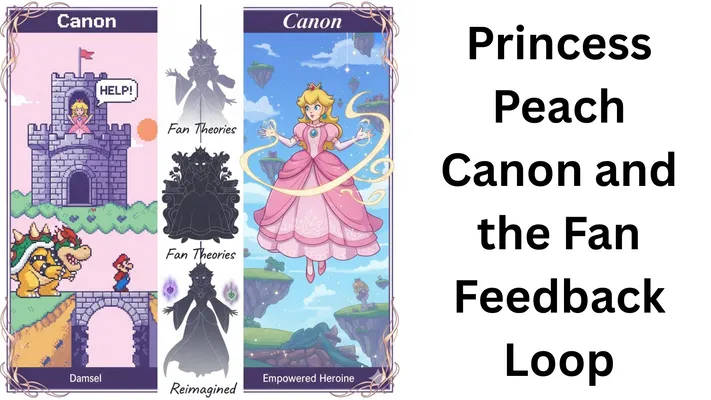
Princess Peach Toadstool is a character constructed on a Damsel in Distress model, a role which she has portrayed since 1985 when she was first introduced. Peach is a princess in real life, and the king of the Mushroom Kingdom. Her principal characteristics are that she is a plucky, naive and a kind-hearted girl, and she reigns kindly and politely. Her very first appearances cemented her role as a plot device the prize that was stolen to accelerate the main character, Mario, in his quest. In core games such as Super Mario Galaxy and New Super Mario Bros. U, she had very little spoken in Super Mario World and Super Mario Bros., typically as a cry of ‘Help me!’, or other exclamations, which were supplementing the victim-as-to-be-saved aspect of the role.
We usually refer to this recurring role as the objectified ball or disposable woman, a character who is thrown between the male protagonist and the male villain. This regular criticism inspired fan anticipations that Peach would have increased agency, which would directly affect how Nintendo treats her going forward.
Despite the DiD model still being quite widespread in the very fabric of the games, we find the first premises of resistance to this unchallenging role in the official account. Peach first becomes an effective adventurer with her floating ability introduced when she was introduced as a playable character in Super Mario Bros. 2 (USA). It has its formal paradox: Peach still performs the DiD role in big-budget 3D marquees (e.g. Super Mario 64 and Super Mario Odyssey). These are the basic plot of rescue which Super Mario 64 and Super Mario Odyssey use to motivate exploration, though she is also involved and powerful in spin-offs, 2D platformers, and RPGs. Such distinction is an indicator that Nintendo alters genres strategically, with the well-worn DiD role used in flagship products, but tries out the heroic potential of Peach in other games.
1.2. The Kind Ruler: Her Official Personality and Skill at Peace
Peach is not merely superficial with the strength of physical power, a minor quality against other heroes such as the Mario Bros. and Bowser, but her inner strength and leadership qualities. I discover that the official records focus on how strong willed she was, and that she was a kind and noble-minded person. Her strength is evident when she stood up during crucial periods of resistance like defying intense dark magics and villainous brainwashing by other characters such as Nastasia and the Shadow Queen. It is an essential part of her power base which is often overlooked when looking at her physical frailty.
Peach as a ruler is a dynamic ruler, a ruler who rules the kingdom and signifies peace. Her official work involves hosting events to unite subjects within the Mushroom Kingdom, peace talks with external forces, as in the case of the Beanbean Kingdom in Mario and Luigi: Superstar Saga, and peace talks with other subjects in the Mushroom Kingdom. It is even a bit apparent that she does run a modern, complex state, with the government funding things like hospitals, shopping centers, and automobiles, and enormous expenditures like building stadiums. Her actual power, her soft power, is in brilliant opposition to the straightforward, devastating struggle of male heroes and villains: the power of her good character and the skill to negotiate. Her steadiness and more to the point her inherent strength to reverse the mightiest dark magic spells by Bowser are strengths which one needs to control and protect her people.
We speculate all the time on why she retains the name Princess Peach despite the fact she is the only ruler of the Mushroom Kingdom. Even though fans claim that she is actually a Queen, the official account retains the name of the Princess. One of the theories explains that Peach deliberately keeps this position either as a way to keep the traditions of her kingdom alive or to seem delicate and beautiful, hence not to be described as uncivilized by her subjects or guests.
1.3. Flipping the Role: Her Own Heroic Adventures in the Official Story
The most significant official changes to the narrative are the titles with the protagonist of the story being Peach and DiD being reversed. I consider these heroic side-games to be the desired narrative changes, a commercial response to the outside pressures to give women more agency.
The first large scale flip was Super Princess Peach (2005), which was a deliberate inversion of the primary dynamic between Peach having to save a captured Mario and Luigi. The hotly controversial Vibe powers were also featured in the game, with the power (fire, healing power, and flying power) of Peach being the outcome of a powerful emotional reaction (Imitation, Joy, Rage, Calm, Sadness) to the Vibe Wand. Though critics may have decried the game as a possible reinforcement of emotional stereotypes, it made it apparent that Peach was a strong, effective heroine who could overcome any obstacle with a collection of powers that other heroes could not.
This would continue up to Princess Peach: Showtime! (2024). In this game, Peach has a magical ribbon that, temporarily, grants her combat roles based on transformation such as Mighty Peach, SwordFighter Peach and Ninja Peach. The game exposes her most powerful magical skill, which is the megalithic process of big-scale restoration magic, as illustrated when she comes up with the mending of the severely damaged Sparkle Theater. The reality of being a heroine is her normality, her ability to relish these competent roles, although she can do so only temporarily. Better still, her frequent presence as a playable character in recent mainline co-op platformers, such as Super Mario 3D World and Super Mario Bros. Wonder, predetermines a significant normalization of her active and heroic role in the expanded series form.
Nintendo mitigates this risk of this new knowledge by making these battle-savory skills tend to be disposable or contextual, so as to retain her core character in the non-adventure hits as a coy-looking, harmless sweetheart.
II. Powers Comparisons: Powers between Powers: Official Limited Magic and Fan-Made Total Power
2.1. Unstable Powers and Main Skills of Official Story.
We see that the formal powers of Princess Peach change based on the game, a required tradeoff between story and gameplay by Nintendo. In platforming games, she utilizes traditional power-ups (e.g. Fire Flower, Elephant Fruit). The signature movement which she always uses is the float/glide although the source of this move is vague. In others, it is suggested to be her dress; in others there is some allusion to a little magical element with glitter.
Peach is perpetually on her special authority in the supportive and healing functions. In the early manuals it is made clear that she possesses a certain magical ability to reverse dark magic in the form of Bowser spells that convert Toads into blocks. In addition, in role-playing games like Paper Mario and Super Mario RPG, she is able to heal, canonically so, and thus resembles a white mage. Her magic does not react to an assault forcing her to resort to more conventional weaponry, such as the frying pan, a spin-off age-old personal weapon.
This official restriction of her offensive and curative powers and what fans refer to as her active restraint, do not allow her to be too powerful and thus force Mario to save her in the central storylines. The fan interpretation recognizes this structural need and it is this need that leads to theories which endeavor to provide her with latent, ultimate power.
2.2. Fan-Made Powers: Secret Strength and the Reasons She Conceals It
I think the most common discussion about fans is that a character who should have magical ability and strength can still be helpless. It leads to theories that provide an internal explanation as to why she is always the prize, the best-known of these being the theory of Kidnapping as a Strategy. Our reading of this is that Bowser does not have her love in his heart but rather that it is a tactical requirement: to remove her magic healing abilities, the one thing capable of permanently undoing his own dark spells. Seeing Peach as a high-value target restates the conflict as an arms race of magic, and not a romantic exercise.
Also, fan lore rapidly identifies certain instances of her strength as a manifestation of her actual, secret strength. The emotional, unstable Vibe powers of Super Princess Peach are many times considered evidence that she has immense powers that she deliberately holds in check as they are too irregular and unpredictable. Equally, non-canonical, potent feats, like her telekinetic toss of Bowser in Bowser Inside Story (which she frequently repeats in collaboration with Starlow) or the high-effort shots of Radiant Peach in Showtime! are also often sold in fan discussion as an indication of her full potential.
The following table summarizes the tension between Peach’s defined official abilities and their widespread expansion within fan narratives.
| Ability/Power | Official Story Source | Official Function/Context | Fanon Interpretation/Expansion |
|---|---|---|---|
| Floating Glide | SMB2 (USA), Spin-offs | Basic movement skill, often attributed to her dress. | Inherent, subtle magic; suppressed power demonstrating low-level telekinetic control. |
| Magical Healing/Reversal | SMB Manual, SMRPG | Restorative/Supportive; reversing Bowser’s early dark magic. | White Mage Mastery: a strategic asset whose neutralization is Bowser’s primary goal. |
| Vibe Powers | Super Princess Peach (DS) | Artifact-dependent (Vibe Wand); temporary, emotion-driven offense/defense. | Evidence of powerful, volatile psychic connection; potential for destructive emotional volatility. |
| Restoration/Telekinesis | Showtime!, BIS | Contextual, artifact-related abilities: repairing massive damage, throwing Bowser. | Confirmation of high-level sorcery potential, often exceeding that of Mario or Luigi. |
| Table 1: Canonical Abilities vs. Fanon Expansion |
III. Different Stories and Fan-Made Roles: Changing the Narrative
Fan theories exist largely to resolve the character’s internal contradictions and the series’s story stagnation, creating complex, often dark, roles that contrast sharply with her kind, official persona.
3.1. The Secret Ruler: The Political Mastermind Fan Theory
One of the oldest fan-created plots is the hypothesis that Peach is no victim, but she is an astute Political Mastermind, who purposefully lets herself be caught. This is a fairly complicated theory that, nevertheless, is expected to give an internal explanation of the repetitive plot structure at Nintendo.
The reasons attributed to this intended takeoff are:
- A Break from Work: Being captured is a needed respite of the tedious, demanding work of ruling Mushroom Kingdom.
- Public Safety and Diplomacy: Peach sacrifices her freedom to keep her subjects safe by becoming the one object of Bowser aggression so that an unpredictable war could be avoided. This is also a diplomatic strategy to have her kingdom united against a foreign power.
- Image Control: Maintaining the official appearance of the Damsel in Distress, she sustains a feminine appearance that the population needs, that is, not to be seen as uncivilized, which can be detrimental politically.
This theory increases the authority that Peach has on her life by transforming a passive failure into an active and strategized act. It brings with it an element of real politics and depth- considering the Mushroom Kingdom as being a state that is vulnerable to issues of governance, which are way beyond the simple fantasy-focused aspect of the core games.
3.2. Darker Fan Theories: Princess Peach as the Real Bad Guy
An even more extreme fan culture inverts the character’s ethical position entirely, portraying her as the secret villain. The most common theory is that the whole Super Mario franchise is propaganda being played out through the use of staged plays.
Within this Staged Show Theory, Peach leverages the rescue motif to frame Bowser and portrays herself as a victim, free from political or financial troubles. This theory frequently appeals to the moral grayness we observe, pointing to Bowser, at times, being treated with redeeming or even noble traits (e.g., self-sacrifice in Super Paper Mario), implying that he is just a strong ruler who is again and again put into the position of being framed by the Princess.
Radical theories even view Peach as an outright Evil Witch or manipulator, capitalizing on moments when she is corrupted (like the Shadow Queen possession in Paper Mario: The Thousand-Year Door) or where her special magic hints at an unsafe amount of power. If Peach is the real villain, the whole moral system of the Mario World unravels, retroactively making Mario out to be a chess piece and granting the audience the chance to dig into hidden corruption and power within the apparent benevolent Mushroom Kingdom.
3.3. Guessing Her Family Tree: The Rosalina Link
Nintendo’s approach to character family history is purposely unclear, stating only that Peach was “born a princess.” This intentional omission has resulted in extensive fan efforts to construct a single, complete story history, most notably through the theories linking Princess Peach to Rosalina, the powerful overseer of the cosmos from Super Mario Galaxy.
These theories are fueled by visual similarities and close reading of Rosalina’s Storybook. Popular variants include:
- Rosalina as Peach’s Daughter: This variant posits Rosalina as Peach’s time-traveling daughter.
- Rosalina as an Ancestor/Sibling: Other interpretations suggest Rosalina is a lost sibling or an indirect ancestor who fled the Mushroom Kingdom centuries ago, explaining why she and Peach share physical traits.
We believe the community’s commitment to these “Grand Unified Theories” demonstrates a profound demand for deep, fixed continuity, similar to the dense mythology found in the Legend of Zelda series. This actively fills the voids left by Nintendo’s preference for simple, episodic lore.
3.4. Relationships: The Unclear Story of Mario and Bowser
The official explanation of the love story between Mario and Peach seems to me to be deliberately ambiguous, so the primary basis of the fan speculation. Nintendo veterans on record vehemently deny that there is any romantic interest of any kind between Mario and Peach, and such a suggestion is gossip between mushroom kingdoms. Though Peach frequently kisses Mario upon their rescue, this is never presented as a climactic romantically-charged act, but as a reward, or even as a completion of a story cycle.
This ambiguity is a sophisticated narrative technique that has business significance since it has a broad appeal and longevity of the franchise since the focus on adventure is not restricted to relationship constraints. However, this vague aspect irritates some circles of enthusiasts, and some of them yearn to discover more overt romance or the intentional propagation of fabricated mythology, e.g., the hoax that Peach is betrothed off records to a prince.
The official relationship between Bowser and Peach, in turn, is even clearer: the latter is in love with Peach and offers numerous proposals to marry her. The motive is also furthered into fan analysis, where it is combined with the magical need mentioned earlier: Bowser kidnapping attempts are perceived as a chess game, both geopolitical and magical, rather than a failed love affair and the antagonistic relationship is viewed as a strategy. Nintendo has established ambiguity, which is computed to enable the flourishing of fan tale and romantic relationships.
IV. Summary: Bringing the Two Sides Together
4.1. The Loop: How Fans Change the Official Story
The character development of Princess Peach can also be shown as an efficient feedback between the sentiment of fans and the official story development. The DiD mode has been under sustained criticism and the increasing demand to have female characters in games playable and capable has seen Nintendo transform her role considerably in the last 20 years. The agency-seeking demand by the audience was swiftly followed by the release of the Princess Peach: Showtime!, as the character in Super Mario Odyssey shouts Enough! when she is on her way to save another princess, and the market promptly responded in kind.
The difficult balancing act of Nintendo has been to present Badass Peach without writing in a manner that would make her all-powerful and distort the roles that Mario and Luigi had. The official model that Peach is currently operating under, where her best fighting skills are confined to unique skills, temporary abilities, or skills that are based on artifacts ( Vibes, Showtime! transformations ), is an effort at a delicate balance between agency and maintaining the structural dynamics of franchises.
4.2. The Future of the Official Story
The Princess Peach fan theories can be seen as an audience-wide attempt to extrapolate, justify, and further develop the character in a way that was not offered by the platforming game format. Fan texts are interested in complex politics, power and personal relationships that the official, episodic narrative of the story is specifically designed to avoid.
The willingness of Nintendo to continuously incorporate into the official narrative the previously demonstrated diplomatic and heroic skill of Peach beyond its status as a default kidnapping plot will determine its future as a character. An effective integration should apply her distinct form of the so-called soft power, such as restorative magic, political negotiation, and strong leadership, as key elements in the solution of core series conflicts, and so confirm the sophisticated interpretations formulated by fan theories without undermining her fundamental, humane substance.
The following table summarizes the causal relationship between canonical limitations and the subsequent development of pervasive fan roles.
| Fanon Archetype | Core Idea | Official Story Reason | Underlying Critique of Official Story |
|---|---|---|---|
| Political Mastermind | Feigns capture for strategy or to escape bureaucracy. | Inconsistent agency; canonical competence in diplomacy. | Critique of the DiD trope as structurally lazy. |
| Suppressed Sorceress | Holds back immense magic that could defeat Bowser instantly. | Inconsistent magic set (healing/reversal); strong resistance to brainwashing. | Critique of the power imbalance and the necessity of Mario. |
| True Villain/Propagandist | Uses the DiD narrative to slander Bowser and control the populace. | Bowser’s occasional nobility; the cyclical, senseless nature of conflicts. | Critique of moral simplicity and lack of narrative stakes. |
| Rosalina’s Relative | Part of a grand, cohesive family history (daughter/ancestor). | Canonical ambiguity regarding family, visual similarity, and storybook details. | Critique of shallow, episodic lore structure. |
| Table 2: Fan Roles and Their Official Story Drivers |
In conclusion, Princess Peach holds a unique place in gaming lore, constantly moving between a canonical plot device and an increasingly capable heroine. Fan theories do not simply reject the official character; rather, they attempt to rationalize the official inconsistencies. By introducing sophisticated motives (the Political Mastermind, the Strategic Target) and hidden origins (the Rosalina connection), fans transform the shallow story structure of the mainline games into a deep, complex, and politically charged universe where the characters’ actions are fully justified.