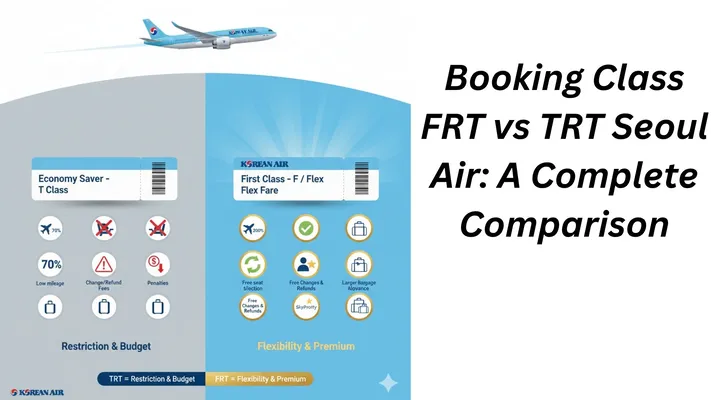
1. Introduction and General Information.
Speaking about the booking class FRT vs TRT of Korean Air (it is also known as Seoul Air), we should pay close attention to the price setting system used by this airline. The limits of the booking class range (RBDs) are industry abbreviation FRT and TRT. Being the flag carrier of South Korea and one of the main participants of the SkyTeam alliance, Korean Air has a complex, multi-tiered pricing system. The idea is to divide customers into segments in regards to the amount they can pay to get additional benefits, priority, and loyalty points.
To make the comparison between FRT (Full Rights Ticket equivalent) and TRT (Tariff Restricted Ticket equivalent) it is necessary to match those features with the official Korean Air fare brand Saver, Standard, Flex, Prestige and First Class. These fare brands set the essence of the principle rules of each ticket, whereas the single-letter RBDs are primarily applied to the handling of the inventory of seats.
1.1. Decoding Ticket Names: Cabin Class, Booking Class (RBD) and Fare Rule Code.
To be able to learn the distinction between FRT and TRT, it is important to learn three major terms:
- Cabin Class (Service Product): This is the generic that informs you of what you will be receiving in the form of a physical product and service, whether it is Economy, Prestige (Business), or First Class.
- Booking Class / Revenue Booking Designator (RBD): The one letter displayed in reservation systems (e.g. F, J, Y, T). It records the number of seats at a particular price. A full-fare First Class RBD, such as F, business RBD, such as J, or economy RBD, such as Y, would commonly be the most expensive inventory in that cabin.
- Fare Basis Code (FBC): The detailed alpha numeric code that has the precise regulations of the ticket. FBC provide you with FRT or TRT, establishes limits, eligibility to upgrade, refund policies, and rate of mileage earnings- frequently unrelated to the actual cabin.
The difference between the most flexible fare (FRT equivalent) and the most restrictive fare (TRT equivalent) is established in the FBC. Not only the initial price, but also what happens in case you change or cancel, the penalty and how many miles of loyalty you lose or earn is defined by that code. Through a modification of these rules, Korean Air will be able to segment the market suitably, aligning the requirements of customers who value flexibility and future loyalty favoritism with those who merely want to get the best deal.
1.2. Fitting the Names: Understanding FRT and TRT as applied to KE Fare Brands.
I have equated the features of the FRT and TRT to the fare structure of Korean Air using industry standards.
- FRT (Hypothesized Flexible/Full Rights Ticket): This plane is the most flexible tickets. The equivalents of Korean Air in this example are First Class ( RBD F ) and Flex Fares in all cabins ( Economy Flex Y, Prestige Flex J ). These fares enable the traveler to buy to the maximum. These are characterized by: no or minimal change fees and refund, highest possible earning (100 to 200) of miles, and free and inclusive additional services.
- TRT (Hypothesized Restricted Tariff Ticket): This level is associated with the most discounts with the highest restrictions. The Korean Air analogs are the Economy Saver – (RBDs-L,U,Q,T) and especially the very restriction T Class. The key features are high penalty fees when making changes and refunds, a great deal less or no mileage credit, no pre-selecting seats, and limited geographic usage.
The difference in price between a restrictive TRT equivalent and a flexible FRT equivalent is not just a cost difference but I consider it a cost of safety. Travelers purchasing FRT tickets incur a premium fare to offset the risk of changes in trip to the airline which might occur in the future, whereas TRT travelers accept the risk and still wish to keep they initial ticket price as low as possible.
2. Full Look at Korean Air International Fare Categories
Korean Air divides its international fares between all cabins, which establishes a distinct hierarchy of restrictions and privileges. Such hierarchical distinction is central to our realization of harsh constraints of the TRT model and the generous benefits of the FRT model.
2.1. Economy Classification: Saver, Standard and Flex Brands.
- Saver (Deep TRT Equivalent): This brand involves RBDs L, U, Q, T and is the most limited of the offerings of the airline. Changes in policy recently indicate that the Saver brand typically lets customers have a single bag of checked luggage and that it is not available across all regions. When it is booked online, it usually covers high volume, short distance routes like Korea to Japan or China.
- Standard: This intermediate level covers RBDs S, H, E, and K (and also is occasionally identical to Saver RBDs). It has a bit more favorable terms than Saver but, nevertheless, charges remarkably high change and refund rates.
- Flex (Entry- level FRT Equivalent): Economy Flex is the uppermost level of flexibility and service in the economy cabin using RBDs Y, B and M. Those fares usually allow free upgrades (Y class), ensure earning of full mileage and provide case of future upgrades of the seat with the help of miles.
2.2. Premium Cabin Hierarchy: Prestige (Business) and First Class
The premium cabins represent the FRT standard, which is more about convenience and flexibility:
- Prestige (Business) Class: It has Flex (J Class), Plus (C), and Standard (D, I, R) classes. The Prestige Flex (J Class) is allowing free ticket changes and refunds, which proves its premium FRT product nature.
- First Class: This cabin is the fourth example of the FRT concept but it is identified by RBD F. It offers 200 percent mileage per purchase and also automatically eliminates change fee and refund fee.
2.3. The Extreme Restriction of T Class (Deep TRT Analysis)
The T Class RBD is the most restrictive ticket in the restricted structure, which proves the fact that it is a deep TRT equivalent. The boundaries are so harsh such that it goes round the normal incentives that are offered to loyal customers.
A common sale of the T Class RBD would be as a promotion or greatly reduced Economy Saver ticket. It does not provide free basic services including selecting the seat in advance. The policy of Korean Air also denies high-ranking elite members (such as members of the Million Miler Club or Morning Calm Premium Club) the right to select high-demand extra legroom seats gratis when their ticket is T Class.
Any decrement in the value of the T Class even among loyal customers demonstrates a definite policy decision: the highest priority should be given to the revenue generated by the lowest fare, rather than the elite benefits of additional services provided. As such, a corporate traveller who purchases a deep TRT fare (T Class) will lose the perks that they have earned as a result of this elite status and will be required to purchase high-value amenities that would otherwise be free. This reduces the actual cost savings of lowest fare.
TRT-equivalent model of restrictive pricing is primarily utilized in high volume and competitive routes (particularly, between Korea and China or Japan) when tickets are purchased online. These focused limitations indicate that deep-discount strategy is aimed at the market-share rivalry. Airlines prefer more flexible Standard or Flex tarriffs on lower competitive, long-haul routes.
3. Detailed Comparison: Ticket Features and Price Differences (FRT vs. TRT)
The differences we can measure between FRT and TRT equivalents are most clearly seen in the cost structure and the rules governing ticket usage.
3.1. Price Levels and Budget Needs
TRT fares (Saver) are sold as the lowest fare point, so it is appealing to people whose biggest worry is staying within their budget and who are very unlikely to change their travel. The difference in price between the Economy Standard and Economy Flex is very high at a price of added flexibility. FRT fares ( Flex and First-Class ) are priced significantly higher and it includes the price of flexibility and premium bundled services. The risk premium of FRT model is the gain of shifting the risk of variation over to the airline.
3.2. Chart Comparing Key Ticket Features
The following table contrasts the critical operational attributes of the highly restricted TRT (Economy Saver/Standard RBDs) and the highly flexible FRT (Flex/First Class RBDs).
Comparative Matrix of Korean Air International Fare Attributes (FRT vs. TRT Equivalents)
| Feature | TRT Equivalent (e.g., T Class, Saver) | FRT Equivalent (e.g., Y, F Class, Flex) | Source RBDs |
| Fare Category | Economy Saver/Standard (Restrictive) | Economy Flex, Prestige Flex, First Class | T, L, U, Q vs. Y, B, M, J, C, F |
| Change Ticket | Fee Applied, High Penalty | Y/J/F: Free of Charge | |
| Refund Ticket | Fee Applied, High Penalty | Y/J/F: Free of Charge | |
| Mileage Accrual (KE SKYPASS) | Low: 0% – 100% (Q, T: 70%) | High: 100% (Flex) to 200% (First) | |
| Seat Upgrade Eligibility | Not Possible | Possible (Y, B, M, C, J) | |
| Advance Seat Selection (Free) | Possible (T Class: NOT Possible) | Possible (Always) | |
| SkyPriority Eligibility | Only via Elite Status (SkyTeam Elite Plus) | Automatic (First/Prestige Class) |
4. Analysis of Flexibility: Change, Reissue, and Refund Rules
I see the financial risk of the traveler to changes and cancellations as the most significant key difference between the two fare types.
4.1. Fees for Changes and Who is Exempt
TRT equivalent fares (Saver/Standard) are paid with certain change fees, as well as difference between the new ticket price. These fares will discourage amendments. In a sharp contrast, FRT equivalent tickets (Flex and First Class) are classified as high value products and automatically not charged service fee, even the fee may be charged on changing or purchasing of a ticket through the services of the airline service centres or airport offices.
The airline safeguards its revenues by being very strict. No-show fee is imposed when a passenger fails to board the plane after checking in or fails to cancel his reservation beforehand. Moreover, there is a charge of special lounge penalty in case a passenger visits the premium lounge and fails to board the flight. This is important to ensure that the high-value amenity is not wasted and also ensure that capacity is not wasted especially in the high-end FRT segments.
4.2. Different Refund Rules and Rising Costs
Penalties on refunds are growing rapidly at TRT-equivalent tickets according to the length of flight and proximity of the refund request to the departure date.
Whereas FRT tickets (First and Flex classes) typically have a free-refund, the consequences of a restricted TRT classes on long-haul flights may be significant. An example is that Prestige Standard RBDs (D, I, R) on long-haul flights will result in a fee of up to KRW -450,000 in the case of a refund within three days of departure. This increasingly rising fee system poses an economic condition in which the large penalty fee on a restricted ticket can tend to eat most of the initial purchase price up. This is a practical implication which proves that a majority of the highly restricted TRT fares are virtually non-refundable under a consumer perspective.
A major complication occurs with mixed fares: when a journey contains sections on which the rules of the refund vary, the refund is always liable to the provisions of the stricter rule in the order. In this way, one TRT segment may invalidate the full refund right of other otherwise-flexible FRT segments using the same ticket.
4.3. Refunds for Airline-Caused Problems
In instances of problems caused by the airline, the ticket class difference doesn’t matter anymore. If a traveler is subject to involuntary changes, such as flight cancellation, an international delay of six hours or more, early departure of six hours or more, a change in destination, or a cabin service downgrade, the traveler is eligible for a full refund of the unflown ticket portion, including taxes and prepaid extra fees.
5. Extra Services and Flight Perks
The difference in what they provide between FRT and TRT equivalents decides how easy and prioritized the passenger’s experience is during the journey.
5.1. Checked Baggage Allowance
Baggage allowance is different based on both the ticket class (FRT/TRT equivalent) and the specific geographical trip, reflecting targeted pricing in competitive markets.
Korean Air Checked and Carry-On Baggage Allowance Comparison
| Cabin Class | FRT Equivalent Examples | Checked Allowance (Transpacific/Americas) | Checked Allowance (Asia/Europe/Other) | Carry-On Allowance (Max Total Weight) |
| Economy (TRT/Standard/Saver) | Saver/Standard (L, U, Q, T) | 2 pieces (max 23 kg / 50 lb each) | Varies, often 1 piece (23 kg) or 20 kg total | 1 piece + personal item (max 10 kg / 22 lb total) |
| Prestige (FRT Equivalent) | Prestige Flex (J, C) | 2 pieces (max 32 kg / 70 lb each) | Max 30 kg total | 2 pieces + personal item (max 18 kg / 40 lb total) |
| First Class (FRT Equivalent) | First Class (F) | 3 pieces (max 32 kg / 70 lb each) | Max 40 kg total | 2 pieces + personal item (max 18 kg / 40 lb total) |
Export to Sheets
Sources:.
FRT passengers (First/Prestige) benefit from a much larger carry-on limit (two bags, 18 kg maximum), compared to TRT passengers (Economy), who are limited to one bag totaling 10 kg.
5.2. Choosing Seats Early (ASS): Rules and Limits
The TRT equivalent fare structures limit choices for seats. While Economy Saver/Standard generally allow ASS up to 48 hours before departure, the most restrictive T Class is clearly not allowed to get complimentary advance seat selection. This is reinforced by the rule requiring T Class passengers, even elite members, to purchase access to preferred extra legroom seats.
This targeted restriction shows a core part of the extra revenue strategy: make money from popular perks on the cheapest tickets. The low price point of the deep TRT T Class requires paid add-ons for services considered basic privileges in other fare classes, thereby increasing the effective total cost beyond the advertised price.
5.3. Who gets SkyPriority and Fast Airport Services
FRT equivalent fares (First and Prestige Class) automatically include SkyPriority services, ensuring a smooth, fast airport experience through priority check-in, baggage drop-off, security/customs lanes (where available), and priority boarding.
TRT equivalent passengers (Economy) only receive these valuable SkyPriority benefits if they hold a qualifying elite status, such as SkyTeam Elite Plus. The difference between FRT and TRT is thus measurable in terms of time cost: FRT passengers purchase a service that maximizes efficiency by minimizing time spent waiting in airport queues, a critical advantage for corporate travelers.
6. Loyalty and Upgrade Potential
The impact of FRT versus TRT selection on the traveler’s built-up loyalty value and future travel options is big, marking a difference between building loyalty over time and just getting a cheap ticket now.
6.1. Earning Miles: Keeping Customers or Just Selling Tickets
Mileage earning rates define the long-term benefit of the ticket purchase. The difference between the fare extremes is designed to greatly reward high-yield passengers:
FRT (First Class/Flex): First Class (F) earns 200%, Prestige Flex earns 135%, and Economy Flex earns 100%.
TRT (Saver/Standard): The lowest Saver RBDs (Q, T) earn a significantly reduced rate of 70%.
This big gap (a 130% difference in earning between the lowest and highest tiers) confirms a two-part strategy to keep customers: TRT buyers are treated as one-time customers with high likelihood of leaving, while FRT buyers are strongly encouraged to maintain loyalty through rapid accumulation of miles for status and award flights.
6.2. Can You Upgrade?
The ability to use accumulated miles for future upgrades is only for the flexible FRT-equivalent tiers.
- FRT: Economy Flex (Y, B, M) and Prestige Plus/Flex (C, J) are eligible for seat upgrades.
- TRT: Economy Saver and Standard fares are explicitly designated as “Not possible” for seat upgrades.
The inherent inability of TRT fares to allow future upgrades or faster status acceleration represents a big loss of potential benefit that frequently cancels out the initial price savings, reinforcing the one-time, transactional nature of the restricted ticket.
7. Strategic Conclusions
My comparison between the highly restricted TRT equivalent booking classes and the highly flexible FRT equivalent classes reveals that the choice decides fundamental differences in risk exposure, loyalty attainment, and service quality.
7.1. Summary of Why the Choice Matters
We can summarize the final determination of strategic value:
- TRT (Restricted Tariff Ticket Equivalent) applies to most Economy Saver seats: L, U, Q, T. Reserve only when travelling over short routes like Korea-Japan, or Korea-China. These are practically non-refundable tickets; cancellation can be subject to a penalty of up to KRW 450,000 in the case of long-haul flights, and the conditions expressly do not allow free choice of seat in T Class. Due to low entry price, marginal revenue will be maximized and loyalty will be reduced.
- The First Class ( F ), Prestige Flex ( J ), and Economy Flex ( Y ) are referred to as FRT (Full Rights Ticket Equivalent). It is a corporate and complicated or unpredictable itinerary fare. The premium of flexibility (free changes and refunds) and increased speed of service (built-in SkyPriority) with larger baggage allowances and long-term loyalty (up to 200% mileage accrual) are added to the higher price.
Summary Table of Strategic Disparities
The core differences between the revenue objectives of the two fare types determine the resulting customer experience:
Key Strategic Disparities: TRT vs. FRT Equivalents
| Metric | TRT Equivalent (Lowest Yield/Restriction) | FRT Equivalent (Highest Yield/Flexibility) | Consequence of Choice |
| Risk Exposure | Maximum (High Penalties, Low Refund Value) | Minimum (Free Changes/Refunds) | FRT procurement mitigates financial risk associated with itinerary changes. |
| Loyalty Value | Low (70% Accrual, No Upgrade Eligibility) | High (100% – 200% Accrual, Upgrade Eligible) | TRT choice substantially compromises future status attainment and award travel goals. |
| Immediate Service | Restricted (Paid Preferred Seating in T Class, Standard Queues) | Premium (SkyPriority, Complimentary Seat Selection) | FRT acquisition ensures control over seating and rapid airport processing. |
| Geographic Scope | Limited (Often restricted to specific short-haul markets, KE online only) | Global (Standard application across the KE network) | TRT may not be a viable option for complex or long-haul itineraries. |