Introduction
When we take a careful look at androids and cyborgs, we recognize we must set clear boundaries that go beyond loose fictional ideas. The main difference we find rests on what they are made of and how they started: is the entity a purely artificial machine built to replace a human, or is it a living creature improved by technology for enhancement?
1.1. The Android Paradigm: Artifice, Mimicry, and Autonomous Machinery
An android is basically a robot or artificial being specifically designed to look like a human, usually having a human-like shape. The word comes from the Late Greek androeidēs (manlike), and it suggests a likeness that should, ideally, be hard to tell apart from a biological human. Historically, they were only seen in fiction , but progress in robotics and Artificial Intelligence (AI) has led to the creation of working, realistic humanoid robots.
The composition of an android is made completely of artificial or mechanical parts. It acts as a machine designed to work and complete tasks on its own, without direct human help, though its actions follow complex computer programs set by humans. The main purpose of an android is replacement or imitation: they are built to perform difficult or dangerous jobs, making human life easier, and sometimes acting as companions.
Although the most advanced androids—like those from Hiroshi Ishiguro’s Intelligent Robotics Lab or the prototypes being refined by companies like Tesla and Apptronik—can copy facial expressions and carry out actions , their functions are still very limited compared to humans. This lack of ability shows the main limit for androids: the challenge is not building the machine itself, but achieving human-like thinking and acting. Current android creation struggles greatly with copying the complexity of the human body and, most importantly, the human brain. If the goal is seamless human imitation, the major technical challenge shifts squarely to achieving Artificial General Intelligence (AGI) and providing the complex, detailed motor and social control needed to behave just like a human. Therefore, while machines are great at physical strength, we observe that the struggle for the android is the high hurdle of imitation and complex thought.
1.2. The Cyborg Paradigm: Augmentation, Hybridity, and Bio-Integration
The term “cyborg,” short for cybernetic organism, was created in 1960 by Manfred Clynes and Nathan S. Kline. A cyborg is defined as a living creature (organism) integrated with both organic (biological) and biomechatronic (artificial) body parts. Unlike androids, which are constructed, a cyborg is born biological and then later improved with technology.
The key feature of a cyborg is the blending of technology that uses a feedback loop to restore lost natural function or, more advancedly, to provide enhanced abilities. Real-life uses of cyborg technology are much simpler than fictional stories and are mainly medical. These include various artificial limbs and implants—such as pacemakers or advanced bionic arms—that connect directly with the human nervous system to improve life quality. The core goal is enhancement or restoration of the organic being.
Because humans have used simple artificial limbs for centuries and medical devices like hearing aids for decades , we conclude that cyborg technology is much more mature in the real world and has immediate medical uses than advanced androids. The technical challenge for cyborgs—connecting a machine part to existing nerve and tissue—is simply different from the android challenge of creating consciousness from nothing. Since the organism already possesses the necessary biological operating system (the brain and nervous system), we find that adding technology is technologically easier than complete replication.
This field is rapidly moving toward the “Cyborganic Frontier,” where our research focuses on creating “cyborganic beings” by joining living matter with smart materials. This sophisticated blending includes developing “cyborg tissues”—electronics smoothly embedded within engineered biological structures. A critical result of this bio-hybrid nature is system strength. While requiring specialized medical upkeep, the biological core of a cyborg offers built-in advantages in flexibility and a self-repair (healing) factor that artificial androids must copy externally. The system benefits from being inherently not controlled by one central point and adaptive, allowing the combined biological and artificial systems to reach an improved state by reacting to environmental changes over time.
1.3. Synthesized Distinction: Replacement vs. Augmentation
We can summarize the conceptual and operational differences between androids and cyborgs based on what they are made of and what they aim to do, drawing a clear line between completely artificial replacement and technologically assisted improvement.
Table I: Fundamental Comparison of Android and Cyborg Entities
| Characteristic | Android (Humanoid Robot) | Cyborg (Cybernetic Organism) |
| Core Composition | Entirely synthetic/mechanical; inorganic. | Biological organism integrated with artificial/biomechatronic parts (Hybrid). |
| Origin | Manufactured/Constructed. | Born biological; subsequently augmented. |
| Primary Goal | Replacement of human labor/function; Imitation. | Enhancement or Restoration of biological function. |
| Interface Principle | Self-contained AI/CPU; interacts externally with humans. | Bio-feedback loop; direct interface/communication with organic components (e.g., nervous system). |
| Current Real-World Status | Advanced R&D; Limited deployment. | Medically implemented and rapidly advancing (e.g., neural prosthetics). |
It is important for us to note that the rule generally holds the entities as separate: cyborgs possess biological parts, while androids are considered purely mechanical. Fictional examples, such as the T-800 from Terminator, which wears a flesh suit over a mechanical skeleton, are typically classified as androids because the organic part is not necessary and not integrated into the system’s core function.
II. Decoding the “DTI” Variable: Contextual Analysis
The abbreviation “DTI” when comparing “android vs cyborg,” as we’ve found, does not have one simple, common meaning. A full analysis requires us to look at three different areas where “DTI” matters: popular culture, advanced institutional research, and critical technical engineering infrastructure. Each meaning completely changes how we look at the comparison.
2.1. DTI as a Cultural Phenomenon: “Dress to Impress”
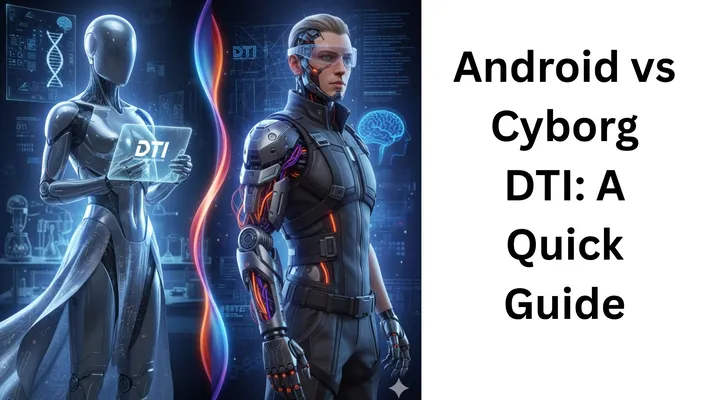
In popular culture, especially within the gaming community, “DTI” refers to the theme “Dress to Impress” on platforms like Roblox, which asks users to visually show the conceptual differences between the two entities.
This fashion challenge makes the public interpretation focus on visual elements:
- Android Look: Outfits highlight a fully robotic, sleek, and artificial appearance. This style typically uses smooth, seamless materials, metallic surfaces, and glowing panels, showing a polished, artificial presence where the technology
- is the entire being.
- Cyborg Look: Outfits mix the organic and mechanical. This means blending human features with technology—adding robotic limbs, gears, glowing wires, or electronic components clearly integrated into the body. While technology can be displayed, advanced concepts often aim to hide and smoothly blend the technology to maintain a more “natural, human-like feel”.
This cultural context reveals that public opinion stresses how visible the technology is. Androids mainly use technology as a display of identity and artifice, whereas cyborgs use enhancement to improve humanity, often trying to keep a human look even with technology inside.
2.2. DTI in Advanced Research: The Danish Technological Institute (DTI)
In a serious technological or institutional setting, we believe DTI most likely refers to the Danish Technological Institute. The Institute acts as a key center for the development and sharing of robotics and AI technology in Denmark and Europe, working as a Digital Innovation Hub chosen by the European Union.
The Institute’s work gives us a strategic platform where the two separate paths of androids and cyborgs are both actively pursued and improved at the same time:
- Android Advancement: DTI focuses on developing and transferring robot technology to businesses, with expertise covering Modern Artificial Intelligence, Human-Robot Interaction (HRI), and the creation of full robotic systems. Projects specifically aim to use AI to let robots adjust themselves to large, unexpected changes and work closely with humans, showing a focus on advanced, independent android systems.
- Cyborg Overlap (Cyborganics): The DTI network, through working with the Technical University of Denmark (DTU), actively supports research in the new area of human-machine life. Publications coming from this network focus on creating “cyborganic beings” that join living matter and smart materials, dealing with challenges in personalized medicine, biomaterials, and smart treatments. This research directly addresses the technical foundation needed for advanced cyborgs, such as self-regulating systems for heart function or insulin creation.
The critical point of DTI’s institutional role is that we see the question “Android vs. Cyborg DTI” as best understood by viewing DTI not as picking a favorite, but as the platform that helps both fields grow. DTI’s work on HRI is key for making sure androids are socially acceptable and safe for human environments , while its expertise in cyborganic material science is vital for making cyborg implants medically possible and improving human lifespan.
2.3. DTI as a Technical Acronym in Cybernetics and Engineering
Beyond the institutional name, “DTI” also stands for short names important to the base feasibility of both android and cyborg building. These technical fields represent the infrastructure challenges that we must overcome for wide deployment.
- Deep Trench Isolation (DTI): This is a method used in semiconductor manufacturing to electrically separate different areas of a silicon chip. This separation is essential for stopping unwanted interactions that hurt performance, allowing for the production of powerful, small, and reliable electronic devices. We find that this technology supports the chips and efficient processors needed for both the software-focused architecture of high-level android AI and the small, powerful hardware parts necessary for embedded cybernetic systems.
- Diffusion Tensor Imaging (DTI): A medical imaging method, DTI is used in brain science to map the quality of white matter pathways in the brain. For creating seamless nerve implants and advanced Brain-Machine Interfaces (BMIs)—key features of advanced cyborg technology—exact mapping of the nerve routes is a must-have. DTI allows the precision necessary for artificial parts to communicate smoothly with existing organic nervous tissue.
- Dynamic Threat Intelligence (DTI): In cybersecurity, DTI gives networks the newest information on advanced cyber attacks and malware. As both androids and cyborgs become more connected and rely on complex systems, we believe DTI networks are essential for making sure these connected physical and cyber systems are secure, whole, and defended before problems start.
These technical DTI fields represent the necessary engineering base. Without the efficiency given by Deep Trench Isolation, the processing power required for complex android consciousness or powerful nerve implants would be physically too big or use too much energy. Similarly, without the diagnostic precision offered by Diffusion Tensor Imaging, the smooth blending of cybernetic systems would be severely limited.
III. The State of the Art: Technological Feasibility and Deployment
Our examination of the current technological directions for androids and cyborgs shows a difference in how ready they are, their purpose, and the required investment, all guided by what they are fundamentally made of.
3.1. Real-World Androids: The Race for Humanoid Robotics
The development of humanoid robots (androids) is currently marked by rapid growth and huge private investment. Companies are speeding up a race to put these robots into the workforce, aiming for economic change similar to the rise of electric vehicles. Analysts predict the humanoid robot market could reach major values in the next decade, potentially involving billions of units working globally by 2040.
These systems are naturally powered by advanced AI, which gives them the ability to sense their surroundings, make their own decisions, and carry out complex tasks. Their design is mostly focused on software, prioritizing flexibility and ease of use through programming. They are already being used in controlled settings such as logistics, manufacturing, retail service, and early roles as companions for older adults.
Despite the clear economic reason—the promise of greater efficiency and productivity—we recognize that the quick spread of androids presents complex social problems. Public acceptance remains a hurdle, with many people viewing these robots as “creepy, dangerous, or unneeded competition”. Furthermore, using independent systems creates a risk of job loss, leading to a wider wealth gap by unfairly rewarding AI investors. The path of development, therefore, is driven by internal company goals for productivity gains, often moving faster than social adaptation and necessary preparation, setting up a path for future social conflict.
3.2. Real-World Cyborgs: From Restoration to Enhancement
Cyborg technology has a much higher degree of medical readiness, having grown from old ideas of artificial limbs to advanced systems blended with biology. Current real-world uses focus on medical need and human recovery.
Recent breakthroughs have created working, closed-loop systems, such as mind-controlled bionic arms that use direct skeletal attachment and electrical signals to give sensation back to amputees. This shows the successful creation of a technology-human interface that actively relies on biological feedback to enhance or restore abilities.
The design of cyborg systems is focused on hardware, centered on direct human-machine connection and the improvement of physical abilities. The future of this technology, shown by the “cyborganic vision,” involves blending the tech in a minimally invasive way:
- Smart Treatments: Biological systems created from smart biomaterials can work like smart machines to manage conditions, such as controlling insulin creation or monitoring and mending heart tissue.
- Nerve Interfaces: The development of syringe-injectable electronics that can shrink and expand makes implant surgery less invasive.
- Precision Health: The combination of advanced cyborganic diagnosis and precision medicine offers the potential for people to stop their diseases before they start.
We see the technological path of cyborgs thus aligns with the ethical principle of doing good. Because the technology aims to solve urgent human health crises—moving toward a major shift in disease management—it generates strong social demand and positive ethical reception. This medical driver gives a strong base that moves development from restoration toward optional enhancement, leading some scientists to view human-machine systems as the next stage of human evolution.
IV. Operational and Logistical Comparison
The distinct makeup of androids and cyborgs leads to fundamentally different needs for production, upkeep, cost, and security.
4.1. Manufacturing and Prototyping Economics
Androids, as completely artificial machines, are built through standardized factory methods. The goal is to build them on a large scale, requiring mass production ability in dedicated facilities, similar to making other complex machines.
Cyborg technology, in contrast, requires highly personalized implementation. Enhancements need custom-fit parts that must be compatible with the body, followed by complex surgical procedures involving specialized medical teams for direct attachment and nerve connection. While the base technology for androids is costly to prototype (due to AI complexity) , we recognize that cyborg implementation carries a high cost for each unit because of the custom-made design of bio-integration and the need for highly specialized medical work.
4.2. Maintenance and System Longevity
We view the upkeep plans for these entities as reflecting what they are made of:
Android Logistics (Purely Mechanical)
Android maintenance focuses on purely mechanical repair—a philosophy of “repair and replace”. Operational continuity depends on clear processes, emphasizing preventive maintenance (PM) to ensure the efficiency, productivity, and profitability of the assets. Failing to use PM and relying on reactive maintenance can increase downtime costs by as much as 40%, whereas scheduled PM can reduce overall maintenance costs by up to 30%. Androids are mainly vulnerable to mechanical wear, hardware component fatigue, and the inherent risks of software becoming outdated.
Cyborg Logistics (Bio-Hybrid)
Cyborg maintenance is naturally more complex, needing a mix of medical and mechanical approaches. Challenges include managing the risk of the body rejecting the implant and ensuring the integrity of the seamless connections between electronic and living tissue.
However, the biological core offers a unique benefit in system life and durability. While mechanical systems face sudden failures due to wear, advanced cyborganic systems may use the host’s ability to react to environmental changes, potentially reaching an improved state over time that exceeds their initial design specifications. Furthermore, the ability of the biological host to heal and fix itself provides natural support to the embedded technology, creating a resilience that purely artificial androids must try to copy externally. The critical trade-off is that mechanical failure in an android is predictable and often fixable by replacement, whereas integration failure in a cyborg needs highly specialized, life-critical medical help.
4.3. Security and Vulnerability Assessment
The security profile of each entity is determined by its core structure. Android systems depend heavily on the integrity of their programming and centralized AI management. Security focuses on protecting the core software, stopping outside hacking of control systems, and ensuring the robot’s trustworthiness during human-robot interaction.
Cyborg systems are open to standard electronic security weaknesses, needing advanced systems like Dynamic Threat Intelligence (DTI) to block sophisticated cyber attacks and malware aimed at their internal electronic parts. Crucially, the deep blending with the human nervous system and the use of biomaterials introduce unique risks, including the danger of targeted bio-hacking (e.g., overriding self-regulating drug release implants) and direct misuse of the nerve connection itself.
Table II: Operational and Logistical Comparison
| Logistical Factor | Android Systems (Purely Mechanical) | Cyborg Systems (Bio-Hybrid) |
| Production Model | Scalable, standardized manufacturing, factory-built. | Personalized, highly customized, requiring specialized surgical expertise. |
| Maintenance Type | Purely mechanical/electronic repair; focused on preventive maintenance (PM). | Hybrid maintenance: requiring both medical intervention and mechanical repair; high specialization required. |
| System Durability | Limited by mechanical wear; subject to predictable failure modes. | Potentially enhanced lifespan via biological self-repair and adaptation. |
| Primary System Limitation | Replication of genuine human consciousness and emotion. | Biological integration stability and minimizing rejection. |
| Key Technical Enabler (DTI) | Deep Trench Isolation (VLSI efficiency). | Diffusion Tensor Imaging (Neural interface precision). |
V. Ethical, Philosophical, and Legal Implications
We find that the biggest differences between androids and cyborgs come from the deeper philosophical questions they raise. Androids challenge the definition of a non-human person, while cyborgs challenge the definition of human identity.
5.1. The Android Dilemma: Consciousness, Rights, and Labor
The development of androids, especially those built to mimic humans, directly requires us to face the fundamental nature of Artificial Consciousness (AC) and sentience. If AC is achieved, complex ethical concerns arise regarding the welfare, rights, and potential legal protection of these entities.
The current ethical and legal view generally treats androids as property or complex tools. Ethically, rights are usually based on vulnerability and the ability to feel pain, traits judged to be missing in artificial objects. Legally, giving legal personhood to robots risks creating unclear legal rules and potentially removing responsibility from human developers or owners for the actions of their machines. Consequently, policy analysis suggests that the focus should be less on the rights of the robot and more on how these technologies affect social relations and systems of power.
This leads to a critical focus on control and trustworthiness. Since defining and measuring artificial consciousness remains largely theoretical and speculative , the immediate regulatory priority is sticking to ethical principles such as transparency, justice and fairness, avoiding harm, and responsibility. Development must prioritize the ability to explain the AI’s decision-making process—to ensure safety and trust.
Furthermore, the economic impact is unavoidable. The mass use of highly capable, independent androids in areas like manufacturing and service creates major risks of widespread job loss. The resulting wealth gap, where AI investors get the major share of earnings, creates a clear threat to social harmony and requires action before the problem starts.
5.2. The Cyborg Imperative: Transhumanism and Identity
Cyborgs represent the core ideas of the movement to improve humans with technology—the philosophy that supports improving the human condition through technology to overcome basic biological limits, such as death and mental capacity. This path suggests the potential transformation of human beings into ‘posthuman’ entities.
The philosophical debate around cyborgs focuses on identity. While the movement to improve humans with technology seeks technological excellence, posthumanist feminist scholars, such as Donna Haraway, use the concept of the “cyborg identity” to challenge the idea that humans are the most important and Western ideas of separation, pushing for a re-thinking of the relationship between humanity and the ecosystem.
Unlike the unclear legal status of an android, a cyborg keeps its fundamental legal personhood because it starts as, and remains, a living creature. The real-world blending of cybernetic improvements confirms this status; for instance, the legal recognition of Neil Harbisson’s integrated antenna within his passport photograph confirms his continuous legal status as a cyborg human.
The main ethical concern shifts from controlling a machine (the android problem) to controlling access to enhancement (the cyborg imperative). The focus of policy analysis is centered on justice and fairness. If advanced human-machine technology can greatly extend lifespan or boost mental functions—as the research on hybrid systems suggests —limited access could cause the creation of a deeply divided society. This access problem raises questions about when optional enhancement might become a required step for economic and social function, fundamentally changing the definition of being human.
VI. Conclusion and Strategic Policy Considerations
6.1. Synthesis of Convergence and Divergence
Our analysis shows that the difference between androids and cyborgs lies in a core conceptual split: the android is a purely artificial machine for replacement, aiming for imitation, while the cyborg is a bio-organic entity focused on improvement through technological blending. The huge technical challenge for the android is achieving true artificial consciousness, while the main barrier for the cyborg is stable, long-term biological integration.
Our investigation into “DTI” reveals that this technological future is being actively shaped by three separate, yet linked, forces: (1) cultural perception and aesthetic visualization (Dress to Impress), (2) institutional research driving both the advancement of independent robotics and human-machine materials (Danish Technological Institute), and (3) enabling technical infrastructure, such as precision nerve imaging (Diffusion Tensor Imaging) and efficient semiconductor separation (Deep Trench Isolation).
Table III: Strategic and Philosophical Comparison
| Area of Comparison | Android (Humanoid Robot) | Cyborg (Cybernetic Organism) |
| Philosophical Debate | Sentience, Artificial Consciousness, Rights of the Non-Organic. | The movement to improve humans with technology, Posthumanism, Definition of Identity/Humanity. |
| Primary Societal Anxiety | Job loss and economic inequality. | Unequal access to enhancement; creation of a segregated ‘posthuman’ class. |
| Legal Status Baseline | Property/Tool; potential for legal personhood pending consciousness. | Human/Legal Person; status remains protected regardless of augmentation. |
| Cultural Aesthetics (DTI) | Sleek, metallic, polished, fully artificial appearance. | Blended, integrated, mixture of flesh and exposed components. |
6.2. Policy and Investment Trajectories
We believe strategic policy must recognize that while androids pose immediate economic and ethical risks related to job loss and control of independent AI, cyborg technology poses deeper, long-term risks related to social fairness and the definition of humanity.
Recommendations:
- Regulating Android Development: Our investment must prioritize the development of trustworthy and explainable AI systems, as supported by institutions like the Danish Technological Institute. At the same time, rules must be set up to lessen the unavoidable economic shock caused by mass automation, addressing wealth gaps and potential job loss. The focus must remain on ensuring androids operate as sophisticated, accountable tools until the philosophical debate surrounding genuine consciousness is resolved.
- Governing Cyborg Technology: Our policy should focus on ensuring fair access to life-improving human-machine technologies coming from advances in precision medicine and smart biomaterials. Given the immediate medical benefits of cyborg technology, we should speed up research into biological blending and minimize how invasive implants are, using advances such as Diffusion Tensor Imaging for better nerve connection quality. The ethical framework for cyborg improvement must be built on the principles of individual choice and fairness to prevent technological advancement from breaking human society into separate, biologically unequal classes.