Executive Summary: Why Choose One Fund Over the Other? (Taxes vs. Easy Use)
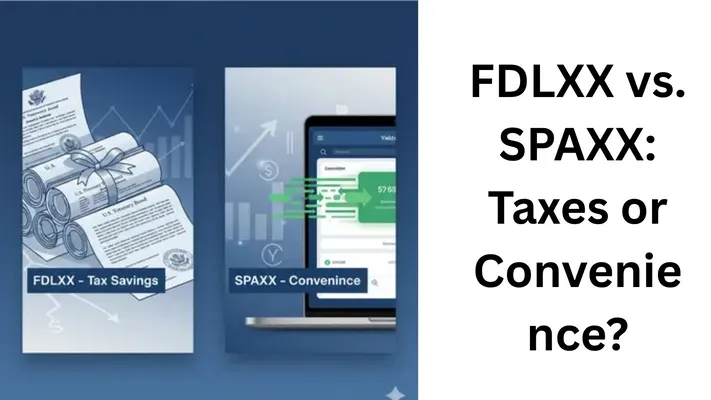
Fidelity manages two primary money market funds: the Fidelity Treasury Only Money Market Fund (FDLXX) and the Fidelity Government Money Market Fund (SPAXX). Both funds aim to protect capital, offer easy access to cash, and maintain a stable $1.00 share price. The decision rests on a trade-off: saving on state taxes versus transactional convenience.
The critical difference rests on their investment mix. FDLXX is set up to hold only U.S. Treasury bonds, which means nearly all its income (97.00% for the 2024 tax year) is free from state income tax. SPAXX, the default fund for daily use, includes other government-backed debt and numerous repurchase agreements (Repos). This mix allows SPAXX to often pay a slightly higher interest rate before taxes (Gross 7-Day SEC Yield), but it also means significantly less of its income is tax-free (only about 55.09% for the same tax period).
For people in states with no or low income tax, SPAXX is usually the superior choice due to its convenience and marginally higher gross yield. However, for people in states with high income taxes (say, over 7%), the massive tax savings from FDLXX become the most important financial factor. In high-tax states, FDLXX’s better after-tax return (Taxable Equivalent Yield or TEY) makes it the best financial choice for cash reserves, despite the need to buy and sell it manually.
I. Introduction and Basic Structure
1.1. How Fidelity Manages Your Cash (The Core Position)
The “Core Position” in a standard Fidelity non-retirement brokerage account holds your uninvested cash. This default investment automatically processes all cash movements: proceeds from security sales, money for purchases, electronic funds transfers, and deposits. The Fidelity Government Money Market Fund (SPAXX) serves as this automatic core option for many accounts. This automatic process gives SPAXX a significant advantage for operational efficiency and immediate transactional use.
FDLXX, the Fidelity Treasury Only Money Market Fund, cannot serve as the automatic Core Position. An investor must purchase it manually, treating it like any other mutual fund. This means cash first settles in the Core Position (usually SPAXX); the investor must then manually initiate a trade to sweep those funds into FDLXX. This required step introduces friction, which investors must weigh against FDLXX’s tax benefits.
1.2. Safety Rules for Money Market Funds (MMFs)
Both FDLXX and SPAXX operate under the strict governance of the Securities and Exchange Commission (SEC) Rule 2a-7. Their main goals are capital preservation and maintaining a stable $1.00 share price.
Important Safety Note: An investment in either fund does not constitute a bank account and is explicitly not insured or guaranteed by the Federal Deposit Insurance Corporation (FDIC) or any other government agency. Fidelity, the fund sponsor, is not required to cover losses, and investors should not expect financial support during market stress.
However, money market funds held in a brokerage account are classified as securities. This distinction means they qualify for coverage by the Securities Investor Protection Corporation (SIPC). SIPC provides protection up to $500,000 (including a $250,000 limit for uninvested cash) if the brokerage firm fails and assets go missing. SIPC coverage does not protect against investment losses, such as a hypothetical drop in the share price below $1.00.
II. Fund Focus and Investment Mix
The specific investment mandates for each fund are the source of their yield and tax differences.
2.1. Fidelity Government Money Market Fund (SPAXX)
SPAXX is the Fidelity Government Money Market Fund. Its mandate requires it to invest at least 80% of its assets in U.S. Government securities and related repurchase agreements. “U.S. Government securities” includes both direct Treasury obligations and securities issued by government-backed agencies (GSEs), such as Fannie Mae or Freddie Mac. Although these Agency securities are very safe, they are generally not guaranteed by the U.S. Treasury, introducing a theoretical, minimal increase in credit risk compared to pure Treasury holdings.
The fund’s holdings show SPAXX utilizes a diverse investment mix. As of an example date (08/31/2025), U.S. Government Repurchase Agreements accounted for nearly half the portfolio (48.98%), and Agency Fixed and Floating-Rate Securities made up 27.35%. Only 27.43% was held in pure U.S. Treasury Bills and Coupons. This strategy, especially the inclusion of Repos and Agency debt, allows SPAXX to capture a slightly higher interest rate before taxes than pure Treasury funds.
2.2. Fidelity Treasury Only Money Market Fund (FDLXX)
FDLXX, the Fidelity Treasury Only Money Market Fund , adheres to a much stricter rule. The fund normally invests at least 99.5% of its total assets in cash and direct U.S. Treasury securities. It must invest at least 80% specifically in U.S. Treasury securities.
This commitment to holding virtually 100% direct U.S. Treasury obligations is intentional. It achieves the highest possible credit safety and, critically, maximizes the amount of income eligible for state income tax exemption. By avoiding instruments like Agency debt and most repurchase agreements, FDLXX maintains the highest standard of credit safety, holding assets backed fully by the U.S. Government.
2.3. How the Holdings are Different
The table below contrasts the funds’ asset requirements, highlighting the difference between a “Government” and a “Treasury Only” mandate.
Portfolio Composition Contrast: FDLXX vs. SPAXX Mandate
| Security Type | FDLXX Goal | SPAXX (Govt. MMF) Holdings (Example Date) | Effect on Risk/Tax |
| U.S. Treasury Bills/Coupons | ≥ 80% (Aims for ≥ 99.5% in cash/Treasury) | 27.43% | Max state tax savings; backed by U.S. Govt. |
| U.S. Govt Repurchase Agreements | Allowed (Kept low) | 48.98% | Main reason for state tax liability; short-term cash deals. |
| Agency Fixed/Floating-Rate Securities | Not Held (Treasury-Only) | 27.35% | Low credit risk; income is usually state taxable. |
SPAXX typically pays a slightly higher gross interest rate because its rules allow it to hold higher-yielding investments that are marginally less liquid or riskier than pure Treasuries.
III. Day-to-Day Use and Access to Cash
The distinction between FDLXX and SPAXX defines how investors interact with their cash daily.
3.1. SPAXX: The Easy, Automatic Fund
SPAXX’s status as the default Core Position ensures absolute operational fluidity. Money you deposit moves immediately into SPAXX, maximizing interest earnings without requiring any action. When you deploy capital—to buy stocks or settle an external transaction—the funds draw directly and instantly from SPAXX without the investor having to execute a manual sale. This smooth, immediate access means SPAXX functions like a checking account for all transactional purposes, including ATM withdrawals.
3.2. FDLXX: The Manual Fund
Since FDLXX cannot be the core position , managing cash reserves within FDLXX demands explicit action. An investor must manually purchase FDLXX shares using the cash accumulated in the Core Position.
This difference is significant when you need the cash. If your FDLXX balance is large and you need to make a purchase, Fidelity’s system prioritizes using cash in the Core Position (SPAXX) first. If the SPAXX balance is insufficient, you must manually sell FDLXX shares to free up the cash for the new purchase or external transaction. While FDLXX shares liquidate quickly, this manual step introduces friction and potential delays that SPAXX avoids entirely. For investors who move cash frequently, this constant manual conversion can negate the minor financial benefits.
3.3. Minimum Investment Requirements
Both funds are highly accessible. Both SPAXX and FDLXX retail share classes generally carry a $0.00 minimum initial investment requirement. This ensures that the investment decision is based solely on risk, tax profile, and convenience, rather than capital availability.
IV. Interest Rate and Fee Comparison
4.1. Interest Rate Comparison (7-Day SEC Yield)
The 7-Day SEC Yield is the standardized metric for comparing money market fund performance, showing the annualized income earned after fees.
Historically, SPAXX typically posts a slightly higher gross yield than FDLXX. This results from SPAXX’s ability to allocate funds to marginally higher-yielding U.S. Government Agency debt and Repurchase Agreements. For instance, SPAXX had a yield of 3.96% , while FDLXX reported an example yield of 3.74% (as of example dates). This approximately 22 basis point difference in pre-tax yield represents SPAXX’s primary tangible benefit.
4.2. Expense Ratios (Fees)
Operating fees show parity between the two funds. Both FDLXX and SPAXX retail share classes share the same Net Expense Ratio of 0.42%. Because the stated net expense ratios are identical, management fees do not factor into the decision. Furthermore, since both are ultra-short-term funds, their sensitivity to interest rate changes (effective duration) is minimal. This ensures that the primary factors differentiating them remain gross yield and tax treatment.
4.3. Comparative Metrics Table
Comparative Overview: FDLXX vs. SPAXX Investment Characteristics
| Metric | Fidelity Treasury Only Money Market Fund (FDLXX) | Fidelity Government Money Market Fund (SPAXX) |
| Core Position Status | Non-Core (Manual Investment Required) | Core Position (Automatic cash sweep) |
| Minimum Investment | $0.00 | $0.00 |
| 7-Day SEC Yield (Approx.) | 3.74% (Example Rate) | 3.96% (Example Rate) |
| Net Expense Ratio | 0.42% | 0.42% |
Export to Sheets
V. State Tax Savings: The Key Difference
For investors who pay state income taxes, the tax-exempt percentage of the fund’s income dictates the investment choice.
5.1. The Tax Rule: Why Treasury Income is Special
Interest income generated from direct obligations of the U.S. Government (Treasury bonds) is generally exempt from state and local income taxation. Funds like FDLXX and SPAXX pass this tax-free benefit directly to shareholders based on the proportion of income derived from qualifying assets.
The substantial gap in tax savings results from the funds’ investment mandates. Many states, including high-tax jurisdictions, do not grant an exemption for income derived from U.S. Government Repurchase Agreements. Repurchase agreements and interest from Agency debt are frequently treated as fully state taxable income.
SPAXX’s large allocation to Repurchase Agreements (48.98% as of the example date) acts like a hidden tax cost. While this allocation boosts liquidity and gross yield, this high percentage significantly reduces the total income investors can claim as state tax-exempt.
5.2. Tax Data Comparison (2024 Tax Year)
Fidelity publishes annual supplemental letters detailing the percentage of ordinary dividends derived from U.S. Government securities. The figures for the 2024 tax year decisively quantify the tax arbitrage opportunity.
| Fund (Ticker) | Full Fund Name | % of Income from U.S. Govt. Securities (2024) | State Taxable % (Approx.) | Source |
| FDLXX | Fidelity® Treasury Only Money Market Fund | 97.00% | 3.00% | |
| SPAXX | Fidelity® Government Money Market Fund | 55.09% | 44.91% |
FDLXX offers about 42 percentage points more state tax-exempt income than SPAXX. This difference dictates FDLXX’s post-tax superiority in high-tax states.
5.3. State Investment Rules
To obtain the exemption, some high-tax states (like California, Connecticut, and New York) require a fund to hold a minimum percentage of U.S. government securities. While SPAXX’s 55.09% eligibility is often sufficient, FDLXX’s 97.00% percentage provides maximum confidence that it will satisfy or exceed all applicable state requirements.
5.4. Calculating Your Real Interest Rate (After-Tax)
The only rate that truly matters is the interest rate you get to keep after state taxes, known as the Taxable Equivalent Yield (TEY). The TEY helps investors determine the state tax rate where FDLXX’s tax savings beat SPAXX’s slightly higher gross yield.
Consider an investor in a state with an 8% marginal income tax rate.
- SPAXX: Since about 45% of SPAXX’s income is taxed at 8%, the state tax bite reduces the effective net yield aggressively.
- FDLXX: Since only 3.00% of FDLXX’s income is subject to the 8% tax, the vast majority of its gross yield is preserved entirely from state taxation.
In this scenario, SPAXX’s small pre-tax advantage is easily erased by the need to pay 8% tax on nearly half the income. FDLXX’s massive tax break (97.00% exempt) renders it the clear choice in the TEY analysis for most states with marginal tax rates above 5%–7%. This demonstrates that the gross yield means little if you neglect the tax profile.
VI. Best Use Strategy
The choice between FDLXX and SPAXX should be driven by state tax domicile and required transactional liquidity.
6.1. Strategy for States with Low or No Income Tax
For investors domiciled in states that levy no state income tax, the tax exemption provided by FDLXX is irrelevant.
- Suggestion: Use SPAXX.
- Reason: SPAXX is the optimal choice. It offers the highest operational convenience as the automatic Core Position and provides a marginally higher gross yield (e.g., 3.96%) over FDLXX (e.g., 3.74%). Without the tax benefit, convenience and gross yield favor SPAXX.
6.2. Strategy for States with High Income Tax
For investors facing high marginal state income tax rates, the tax benefit of FDLXX is the dominant financial factor.
- Suggestion: Use FDLXX for all non-transactional cash reserves.
- Reason: The 97.00% state tax exemption of FDLXX translates to a superior Taxable Equivalent Yield. The significant tax savings outweigh both the slight gross yield difference and the inconvenience of having to manually purchase and sell FDLXX shares.
6.3. The Best Strategy: Hybrid Cash Management
The most effective approach uses a hybrid cash management strategy to leverage the strengths of both funds.
- Suggestion: Keep a minimal liquidity buffer in SPAXX, and allocate bulk cash investment to FDLXX.
- How to Do It: Retain a nominal amount of cash (enough to cover anticipated bills and small brokerage purchases) in the SPAXX Core Position due to its automatic liquidation and transactional utility. Manually sweep any substantial cash balances (e.g., balances exceeding $10,000) from SPAXX into FDLXX to capture the maximized state tax exemption. This minimizes operational friction for daily needs while maximizing the tax efficiency of the bulk savings.
6.4. Final Reminders
Investors must track two key variables:
- Interest Rates Change: The gross 7-Day SEC Yields for both funds are snapshots that change based on Federal Reserve policy and market conditions. Monitor the yield differential continually to ensure the assumed tax arbitrage remains financially compelling.
- Tax Exemptions Change: The critical tax-exempt percentages (e.g., FDLXX 97.00% and SPAXX 55.09% for 2024) are not fixed. They fluctuate annually based on the funds’ portfolio management throughout the year. Always consult Fidelity’s annual supplemental tax reporting statements to confirm the current percentages before calculating your Taxable Equivalent Yield.