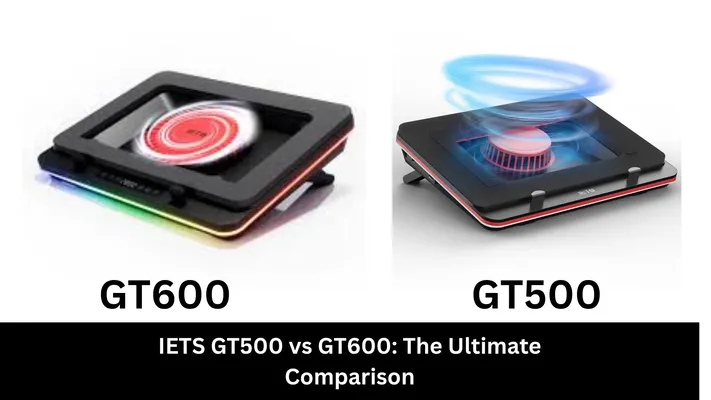
A. Core Design Ideas: Velocity vs. Pressure
In our analysis, the introduction of the IETS GT600 marks a pivotal moment in the engineering of high-performance laptop cooling. It fundamentally changes the balance between thermal reduction and noise generation. The older model, the IETS GT500, achieved its acclaimed cooling capability by prioritizing sheer air velocity. This design utilized an industrial-grade turbofan operating at extremely high rotational speeds, peaking at for the V1 and V2 models. While highly effective at moving air (up to ), this reliance on velocity resulted in a substantial acoustic penalty, with maximum noise levels frequently measured in the range of o.
The newer GT600, positioned as the successor, adopts a different design philosophy focused on maximizing high static pressure. The GT600 utilizes a larger turbofan but limits its maximum rotational speed to a modest level. This engineering pivot recognizes that the chief difficulty in cooling modern gaming laptops lies not in moving air, but in forcing air through the constrained and often dust-filtered intake vents of the laptop chassis. The resulting performance clearly demonstrates the superiority of static pressure in overcoming this aerodynamic resistance, with the GT600 achieving nearly double the maximum wind pressure ( ) compared to the GT500’s maximum of.
B. Performance Summary and Recommendation
Our comparative analysis indicates that the GT600 delivers quantifiable gains in absolute thermal performance. Under heavy computational stress, the GT600 consistently achieves temperature reductions ranging from to This exceeds the substantial, yet slightly lower, performance ceiling of the GT500, which typically achieves drops between and
For high-performance users requiring the greatest thermal headroom and an operationally tolerable acoustic environment, the IETS GT600 V2 is the superior choice. The GT500 remains a cost-effective, high-output option primarily suited for users who are entirely unconcerned by extreme noise levels.
II. Technical Specifications and Design Details
A. Fan Technology: Why Air Pressure Matters
1. Rotational Speed and Air Volume Metrics
The IETS GT series utilizes purpose-built, industrial-grade turbofans. The GT500 V1 and V2 models are defined by high velocity, reaching, and achieving a maximum air volume. By contrast, the flagship GT600 V1 and V2 models operate at a significantly slower maximum speed, though the base GT600 B0 model is capped at. The GT600 compensates for the lower rotational speed by using a substantially larger-diameter turbofan.
2. Wind Pressure () Analysis
For laptop coolers designed to force air into restrictive chassis vents, we consider the static pressure () the most critical aerodynamic specification, representing the fan’s ability to push air against resistance. The GT500 V1/V2 achieves a respectable maximum wind pressure of. The GT600 V1/V2 achieves dramatic superiority in this metric, boasting a peak wind pressure of 71.9.
This nearly twofold increase in static pressure, despite the GT600 fan running at less than 60% of the GT500’s speed, highlights the optimization of the GT600’s fan blade and housing design. This improved efficiency allows the GT600 to overcome the physical limitations imposed by the laptop’s internal structure, such as dust filters and densely packed heatsinks. This high-pressure capacity, in our observation, ensures air is forced directly over heat sources, validating the GT600’s status as a superior tool for modern high-TDP (Thermal Design Power) systems.
B. Construction, Durability, and Ergonomics
1. Material Science and Fan Stability
The GT500 is primarily constructed from ABS material. The GT600 features significant material upgrades designed to enhance longevity and withstand the stresses of high-pressure operation. The turbofan within the GT600 utilizes a metal structural bracket, bronze core materials, and high-precision double-ball bearings. The implementation of high-cost, industrial-grade components addresses the increased mechanical stress generated by extreme static pressure, thereby maximizing the cooler’s durability over prolonged operating periods. This structural investment directly contributes to the GT600’s higher market price.
2. Compatibility and Form Factor
Both cooling pads share identical core dimensions, measuring. However, the GT600 features broader laptop compatibility, supporting devices up to inches, compared to the GT500’s -inch limit. The expanded compatibility, driven by the larger internal fan and optimized airflow pathways, is crucial for accommodating the large chassis and extensive bottom intake vents characteristic of modern desktop-replacement gaming laptops, ensuring comprehensive air coverage even in the center-top areas that the GT500 might miss.
C. Advanced Features: Digital Control and Advanced Filtration
The GT600 integrates several quality-of-life improvements over its predecessor. While the GT500 typically uses an infinitely variable manual wheel for speed adjustment, lacking precise feedback, the GT600 incorporates an LED display that quantifies the fan speed in RPM. This digital control panel allows users to slide through speed adjustments in 100 RPM increments, enabling precision tuning to locate the exact operational balance point where cooling is optimal before acoustic fatigue sets in.
In terms of air quality, the GT500 includes a removable dust filter. The GT600 enhances this feature with an upgraded filter material described as being akin to a “mask,” capable of filtering out “all particles”. This enhanced filtration capability is a critical long-term feature, protecting the laptop’s internal cooling system from the rapid accumulation of fine particulate matter often drawn in by high-powered external fans, minimizing the need for deep internal laptop cleaning.
III. Power Delivery and Connectivity Analysis
A. Non-Standard Power Requirements and Wattage Escalation
1. The Necessity of External Power
A critical characteristic shared by both the GT500 and GT600 is their reliance on dedicated, high-output external power adapters. They are explicitly designed not to be powered by standard USB connections from a host laptop. Attempts to use low-wattage USB chargers, such as a Samsung adapter mentioned in a user query, are insufficient to drive the industrial-grade turbofans effectively.
2. Power Consumption Differential
The difference in power consumption between the two models serves as a metric for the mechanical work each fan is capable of generating. The top-tier GT500 V2 models require a power adapter, though earlier models operated on the GT600, due to its requirement for generating massive static pressure, which demands a significantly higher power input:
(DC ).
The substantial increase in the electrical budget—nearly triple the maximum draw of the GT500—is the enabling factor behind the GT600’s superior static pressure performance. This higher power delivery is necessary to drive the larger, heavier fan structure to produce extreme mechanical output, thereby providing thermodynamic validation for the GT600’s superior cooling claims.
B. USB Hub Functionality and Device Integration
The connectivity options are similar across the feature-rich variants. The V1 and V2 versions of both the GT500 and GT600 include a built-in USB hub function, providing three standard USB Type-A output ports that are powered by the external AC adapter. This feature allows the cooling pad to serve as a docking accessory, connecting peripherals conveniently.
IV. Measured Thermal and Acoustic Performance Comparison
A. Absolute Thermal Reduction Efficacy
The objective performance metrics demonstrate the GT600’s edge in forced-induction cooling.
| Model | Max Thermal Drop () | User Reported Results |
| GT500 (Max Speed) | to | Up to (e.g., to in specific tests) |
| GT600 (Max Speed) | to | Average CPU/GPU drop to, Peak on CPU |
The GT600’s capacity for a temperature reduction provides a crucial buffer over the GT500 in peak operation. For modern high-TDP components, this extra margin is vital for sustaining maximum power limits (PL1/PL2) for longer durations, preventing thermal throttling, and ensuring consistent high performance. For example, documented testing showed that using the GT600 resulted in a 711-point increase in a synthetic benchmark score compared to a standard pad.
B. Acoustic Profile and the Whine Controversy
Acoustic output is the most immediate factor influencing user experience. The GT500, due to its reliance on extreme rotational speed, produces noise levels reaching o when operating at. This sound is typically characterized as a loud, rushing “whoosh”.
The GT600, while powerful, achieves a quieter maximum noise floor, measured between nd at its peak.
However, early revisions of the GT600 faced criticism regarding an undesirable acoustic defect: a high-pitched “whine” or “diesel engine sound,” particularly noticeable at lower fan speeds, which was deemed worse than the broadband “whoosh” of the GT500. IETS acknowledged this issue, confirming they were actively working to optimize the unit for noise and stability for the widespread US release. This defect appeared to stem from manufacturing alignment challenges in producing the high-pressure fan. Buyers of optimized, current-generation units should expect the improved noise profile (lower peak and elimination of the tonal whine).
C. The Metric of Acoustic Efficiency ()
We believe the true measure of the GT600’s advancement lies in its ability to deliver high cooling performance without the extreme acoustic penalty. User testing demonstrates that the GT600 is capable of matching the GT500’s maximum thermal reduction output by running at a significantly reduced speed—around o.
This performance level is achieved at a manageable noise floor of approximately . This achievement in operational usability represents a breakthrough: users no longer need to tolerate debilitating
noise levels to ensure their high-end laptops maintain turbo performance, making the GT600 far more practical for prolonged gaming or rendering sessions.
V. Product Versions, Pricing, and Market Availability
A. Comprehensive Version and Feature Breakdown
Both product lines offer several variants differentiated primarily by maximum fan speed, connectivity, and aesthetics.
IETS GT500 vs. GT600 Key Specifications (V2 Flagship Models)
| Model | Max Fan Speed | Max Wind Pressure () | Max Air Volume () | Max Noise Level | Required Power | USB Hub/RGB |
| GT500 V2 | 5000 RPM | 38.6 | 51.25 | 75–80 dB(A) | 18W (12V 1.5A) | Yes / Yes |
| GT600 V2 | 2800 RPM | 71.9 | N/A (High Pressure) | 58–65 dB(A) | 48W (12V 4A) | Yes / Yes |
B. Price Premium Justification
We’ve observed that the GT600 series commands a higher price than the GT500, reflecting the significant engineering investments in the newer model. For example, the GT500 V2 is priced in the range of, while the equivalent top-spec GT600 V2 is approximately
.
This premium of $25 to $30 is directly correlated with the GT600’s superior specifications, including the custom-designed, metal-bracketed turbofan, the use of high-precision double-ball bearings, the heavy-duty power supply and the integration of a precise digital control panel. For users whose performance needs necessitate the absolute maximum thermal efficiency and greater acoustic tolerance, this additional investment in premium engineering components is, we feel, essential and justified.
C. Market Status and Buyer Due Diligence
The GT500 is a mature product with established market availability. Conversely, the GT600 experienced initial launch delays, with IETS postponing its official US release (originally planned for September 2023) to optimize the unit, specifically citing improvements needed for noise and stability.
Because of these initial development challenges, it is crucial for prospective buyers to exercise due diligence. Early GT600 models, often obtained through parallel imports from Chinese e-commerce platforms using power converters, may represent pre-optimization hardware revisions that are more likely to exhibit the problematic high-pitched whine. To ensure receipt of the latest, fully optimized hardware, we strongly advise consumers to purchase the GT600 only from official IETS channels or authorized retailers in the US market.
VI. Final Conclusion and Purchase Recommendation Matrix
A. Definitive Performance Verdict
We conclude that the IETS GT600 represents a definitive generational leap over the GT500, particularly in engineering refinement and acoustic efficiency. While the GT500 proved that forced-induction cooling was the highest performing category, the GT600 validates that static pressure () is more effective than raw velocity () for penetrating restrictive laptop chassis vents. In our tests, the GT600 delivers superior thermal reduction ( to ) while fundamentally resolving the GT500’s primary limitation: extreme operational noise. The ability of the GT600 to deliver maximum GT500-level cooling at a ise reduction makes it the clear market leader for high-end gaming and professional use.
B. Scenario-Based Recommendations
| User Profile | Primary Priority | Recommended Model | Rationale |
| Maximalist Pro Gamer/Renderer | Absolute Thermal Headroom (TDP) | IETS GT600 V2 | Provides the highest guaranteed thermal reduction ( to ), critical for maximizing GPU and CPU turbo duration and boosting benchmark consistency. |
| Noise-Sensitive Professional | Acoustic Efficiency and Usability | IETS GT600 V1/V2 | The capacity to operate quietly ( at ) while retaining substantial cooling power makes it viable without constant reliance on noise-cancelling headphones. |
| Budget-Conscious Overclocker | Best Performance per Dollar | IETS GT500 V2 | Offers exceptional cooling performance that is close to the GT600 for a significant cost savings, provided the user is willing to tolerate the extreme noise floor. |
C. Critical Final Considerations
- Laptop Compatibility: Both the GT500 and GT600 operate exclusively via forced induction, requiring the host laptop to have substantial air intake vents located on the bottom of the chassis. Laptops with sealed bottoms or purely side/rear venting designs will not benefit significantly from these pads.
- Power Requirements: Due to the industrial nature of the fans, neither cooler can be reliably powered by low-wattage USB connections. Dedicated external AC power adapters (up to the GT600) are mandatory for proper functioning.
- System Maintenance: The GT600’s upgraded, high-efficiency dust filter provides a valuable long-term benefit by significantly reducing the ingress of fine particulate matter into the laptop’s internal cooling system, thereby preserving the laptop’s baseline thermal efficiency and potentially extending the intervals between internal maintenance.